
On Astrology
Putting the (s?)ass in astrology


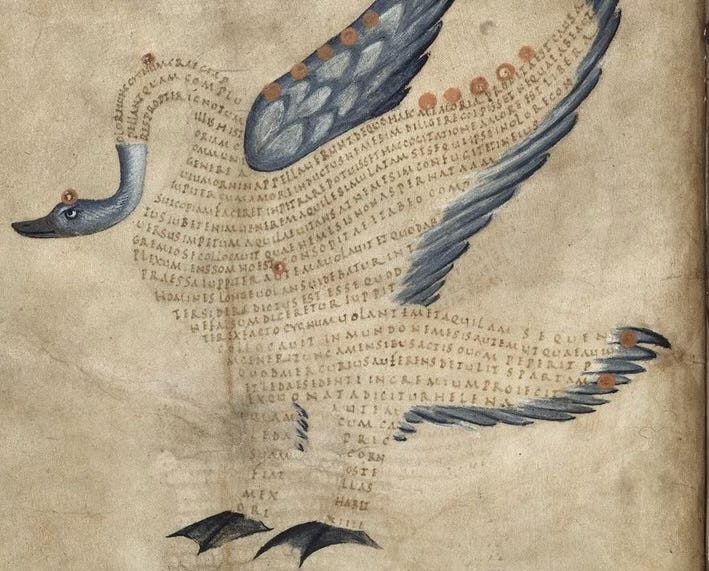
RK: Jason. This is where I have to ask you. What’s your sign?
JWD: Well, I’m a ram, Rhiannon. I don’t buy too much into signs and such, but this issue seems apt as we’ll talk some about people looking for signs and portents in the sky, as in the Christian tradition, three “wise men” did millennia ago - likely not in December, but who’s counting? It also strikes me that early modern astronomers did not see a strong line between astronomy and astrology. which I am sure we will get into later. Anyhow, I’d be remiss if I didn’t ask your sign, Rhiannon!
RK: I’m a Leo (sun and moon!). Does that sounds right to you? I am not much for the horoscope section either, I have to admit. But the subject was so important not only to early modern science, but the whole world of culture, from poetry to medicine to law, that I have found it impossible to ignore! And the process of learning about it has been fun and illuminating.
Astrology as practiced in Renaissance Europe has its roots in ancient Babylonia. Their ideas became a part of Greek culture after Alexander the Great’s conquest of the region, and thus a part of the classical heritage inherited by Medieval and early modern people. Something that struck me when I first started exploring the subject via rare books was how much WORK it all is! To do astrology seriously (of course, there were both serious and unserious astrologers) you need a lot of technical knowledge and a lot of reference books. Before you even get to the issue of interpretation, you need to figure out what planets were where, when. For that you need almanacs and ephemerides—books containing vast charts of location information. Some of the earliest printed publications contain this precious data.
The need for more accurate data for both astrological and astronomical study spurred a lot of important science. Tycho was inspired to create his observatory at Uranibourg to take new observations and Kepler to create the Rudolphine Tables, which provided figures adjusted for his new discoveries about the shape of the solar system. It was the apparent benefits of Copernicanism for astrology that won over Melanchthon to including heliocentric ideas in his physics textbook!
There was not a firm dividing line between “serious astronomers” and “silly astrologers.” Lots of very smart people were devoting their time and energy to astrology. There were, of course, skeptics about astrological thinking even then. One of Kepler’s jobs as court mathematician was making prognostications and drawing up horoscopes, by which—judging from his letters—he seems to have been somewhat annoyed (although, interestingly, quite a few of his predictions came true!1). The historian Francesco Guicciardini publicly ridiculed astrology and was famous as a naysayer. But then a twentieth-century scholar discovered a horoscope drawn up for him at his request by Roberto Malatesta! Pico della Mirandola, who had a wide variety of beliefs one might call outlandish, wrote a vitriolic attack against the whole history and discipline of astrology… and then died the very year predicted by an astrologer.2
In the words of Anthony Grafton in his great book on this topic, Cardano’s Cosmos:
“No philosopher or scientist could escape the cage of assumptions that confined them, compelling them to see themselves, and all other natural beings, as controlled by a network of higher and lower forces, as prisoners writhing in a sticky web of influences.”
Doing astrology involves doing science, but it is as much about politics, economics, and psychology. Predictions were made for (and at the whims of) rulers and patrons, as well as customers and colleagues and friends. It could be a side hustle. You could get thrown in prison for saying the wrong thing. Your findings might determine who married whom, or when someone got medical treatment.
In The Sleepwalkers, Arthur Koestler says “to a questing mind without an inkling of the processes by which heredity and environment shape a man’s character, astrology, in one form or another, was the obvious means of relating the individual to the universal whole, by making him reflect the all-embracing constellation of the world, by establishing an intimate sympathy and correspondence between macrocosmos and microcosmos…unless predestination alone were to account for everything, making further inquiry into the Book of Nature pointless, it was only logical to assume that man’s condition and fate were determined by the same celestial motions which determine the weather and the seasons, the quality of the harvest, the fertility of animal and plant.”
For myself, I’ve come to think of astrology as offering a language and a structure with which to explore and make meaning. I also think about those ancient astrological authors like Aratus, Manilius, and Hyginus, for whom the stories of myth play out in the celestial sphere to provide a mirror to what happens here on earth. The illustrations in these books are some of my favorites of the fifteenth-century print world (and even of the manuscript realm) and they make me imagine a night sky alive with meaning and narrative. I can see the appeal! Too bad I didn’t pay more attention in trigonometry…
Two Cool Things
JWD: When I was in Denmark for AIB in September, we spent a day at the Royal Danish Library. One of their current exhibitions is titled Between Heaven and Earth and was very well done. After the visit, Scott Mandelbrote and I talked at length about the exhibition, wishing for a catalog. The show focused on the history of magic, with dashes of the occult, pagan, and (good news for this issue), astrology. Featured in one of the final rooms was a reminder of something we often mentioned at my former workplace - that early modern astronomers also practiced astrology (as you talk about above, Rhiannon) - and Tycho Brahe was very much a part of this as represented in a manuscript in that final room. I did a little digging in the library’s catalog (mercifully in English, as well as Danish), and so I can tell you that the Tychonic manuscript I saw was this, a natal chart of Prince Ulrik of Denmark (1578-1624), the second born son of Frederik II. Interestingly, the manuscript title page is in German, and the text is in Latin, then German:

Tycho, aside from being a low-key evil science genius (referencing the Nose, the Moose, and the Island Fortress here) was also arguably the greatest naked-eye astronomer, well, ever - thanks in part to the massive instruments (that’s not a double entendre [RK: hee hee]) he had at his island fortress, most famously his mural quadrant. The outsized dimensions of these instruments allowed him to make (for the time) highly accurate observations of objects in the night sky, which were corrected, completed, and published by OUR MAN JOHANNES KEPLER of course. Tycho was from a famous noble family (including the remarkable Karen Brahe, whose library survives), and so had a measurable (if not substantial) income. Also, Tycho’s patron, Frederik II, was the King of an absolute monarchy, and so could do pretty much what he pleased - including funding Tycho’s giant instruments and giving him A FREAKING ISLAND. Ok, sorry: astrology!
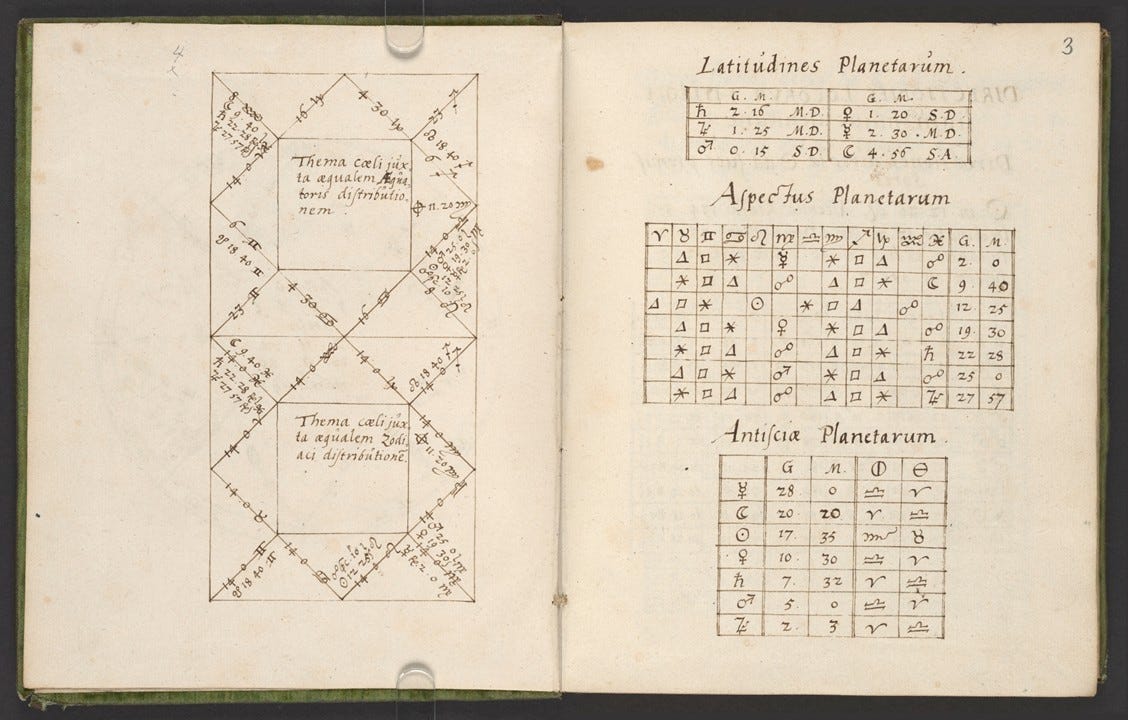
Much like other early modern astronomers (looking at you, Galileo), Tycho made natal (birth) charts for his patrons, called genitures. See the square-in-diamond design above? That’s a geniture, done at the request of the king, for one of his sons. Super thankful that it’s fully digitized, too.
I’ll freely admit I am less familiar with how a geniture is made, but creating one for a known date in the past is reasonably straightforward thanks to long observation of celestial objects, mathematics, and the modeling/predictability that those two things enabled. I recall in one of the Aldines3 that there are genitures for Plato, which seems like a stretch since we really have no idea when he was born… but there is one (RK: ahh but you see, we know what he accomplished—so you can just work backwards from there!). The general concept is that it plumbs the portents of your life based on the location of various celestial objects on the day of your birth. Here’s Tycho (I don’t think that’s his hand) starting his explanatory text, which details the good and the bad that your geniture indicates:

I also love that the copyist/scribe for this manuscript added signatures and signings to the bottom of the pages!
Of course, the most famous portent was not at all in a geniture, but was instead the star over Jesus’ birthplace that brought the three kings. We are sending this issue on January 6th, the day many people in the Christian tradition celebrate Three Kings day (AKA Epiphany - boy, there’s a lot that’s celebrated today), which were led to the infant Jesus by a astrological event! (Kudos to you, Rhiannon, for picking this day. Also, don’t forget to chalk your door if you’re into that.). A great big stonking star in the sky, which apparently was only important for these three dudes in particular? A famous astrological event? Yes. An actual astronomical event? I’ll let you decide that, but it makes for a solid connection to the holidays.
RK: Well, Jason, you’re in luck. Because I have a book about how to make a geniture! And it even has a Tycho connection! The German statesman, humanist, and general rich guy Henrik Rantzau was a sometime patron of Tycho (specifically, he lent him one of his many castles). In 1593, he published a little manual for budding astrologers, Tractatus Astrologicus de Genethliacorum Thematum Iudiciis pro singulis nati accidentibus, in Frankfurt.
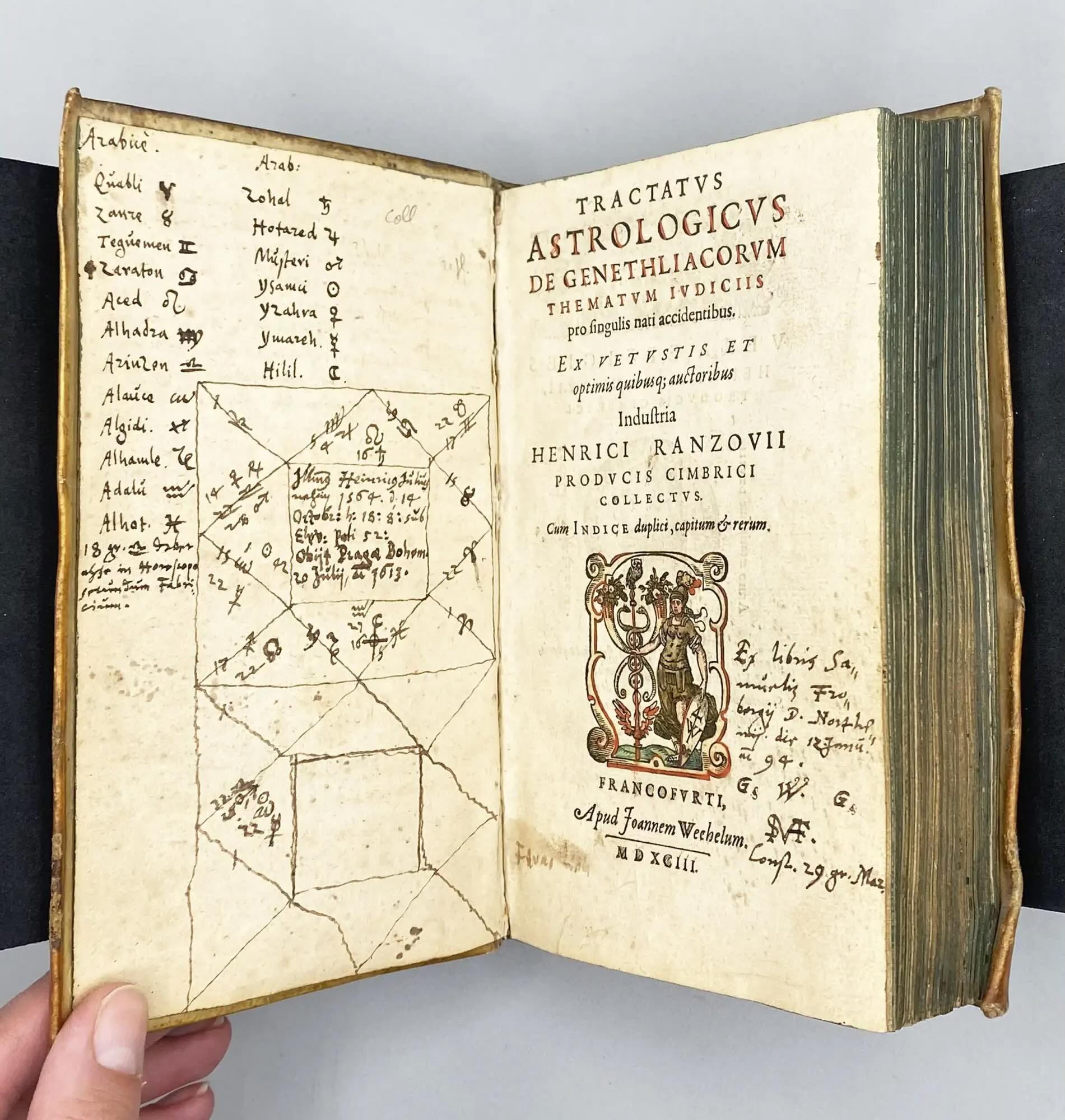
This copy is formerly from the collection of Owen Gingerich, and strikingly hand-colored: almost every single headpiece and tailpiece is decorated in red, green, and ochre.
The text walks readers through everything they need to know for making a horoscope chart. The shape of a geniture represents the twelve houses of the zodiac, usually with basic information about the person in question in the middle. The first house is at 9 o'clock, and they go clockwise from there. Each one governs a different aspect of human life. In Rantzau’s book, you can look up what it means for Venus to be in the second house, or Mars in the first house—with sources to back it up.
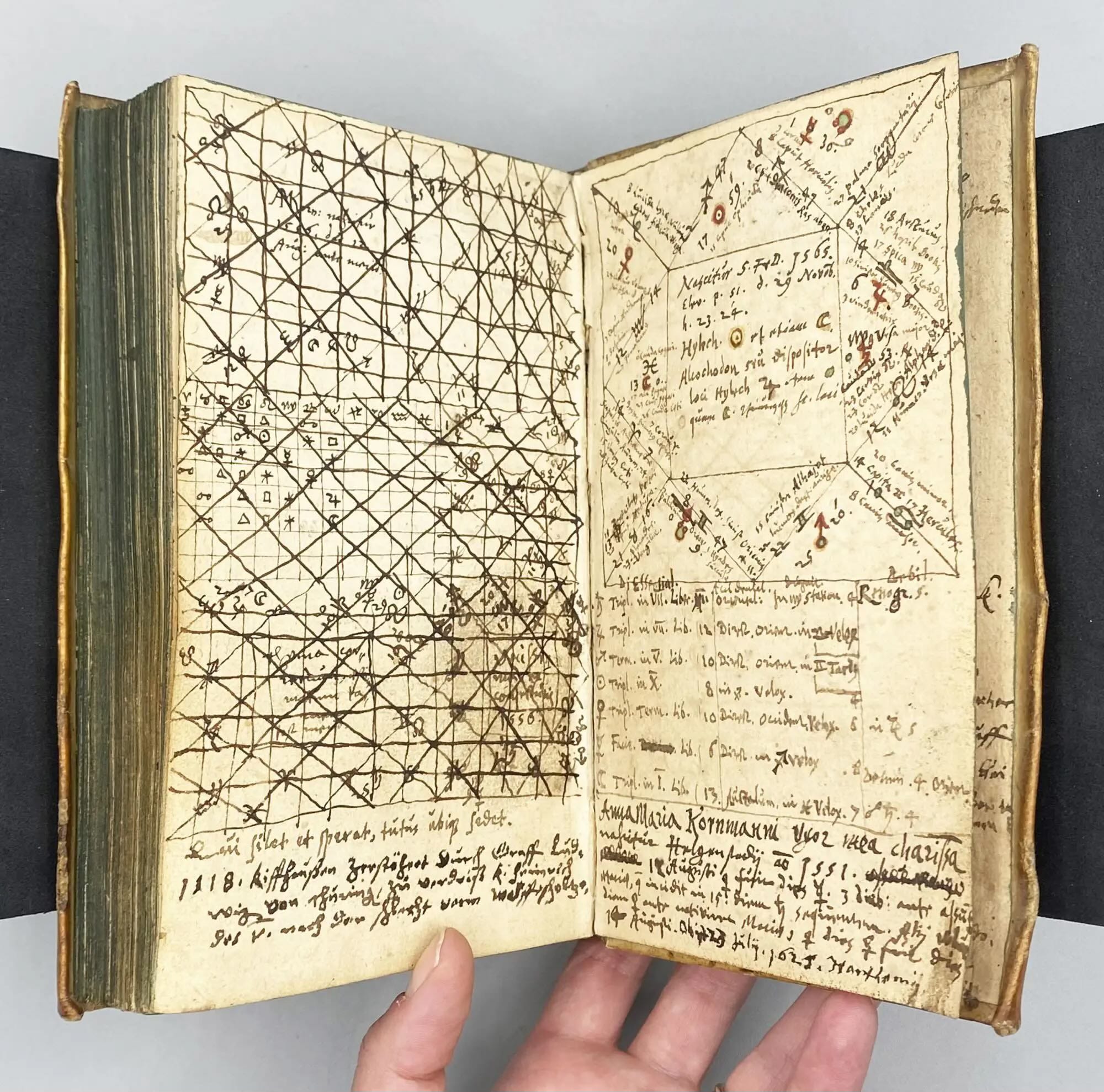
The really special thing about this copy, though, is that it was owned by someone who actually used it to learn to make birth charts. Samuel Froberg was a physician in Northeim, and he bought this book the year after it was printed. He seems to have annotated it basically over the course of the rest of his life. He had a sideline in publishing astrological prognostications (kind of an annual astrological weather report), only a few of which survive.
Among the marginalia he left in the book are three manuscript genitures. Two are for Dukes of Luneberg-Brunswick, of whom he was a subject. The last one is his own! Now, Froberg isn’t exactly a household name. But he did publish a few books and earned himself a mention in the Biobibliographisches Handbuch der Kalendermacher (yes, that’s a real bibliographic database specifically for German calendar makers!). They had to guess his year of birth. But now I, and you, know exactly when he was born: 11:24pm on 29 November 1565 (he was a Sagittarius).
There is a real tenderness for me in these little details of a life about which nobody has thought much for the last 400+ years. At the bottom of the page with his birth chart, Froberg also left a note about his “charisa” wife, Anna Maria Kornmann. He gives information about her birth… and at the end, in what I perceive to be a rather shaky later hand, adds her date of death: July 1625—just two years before his own.
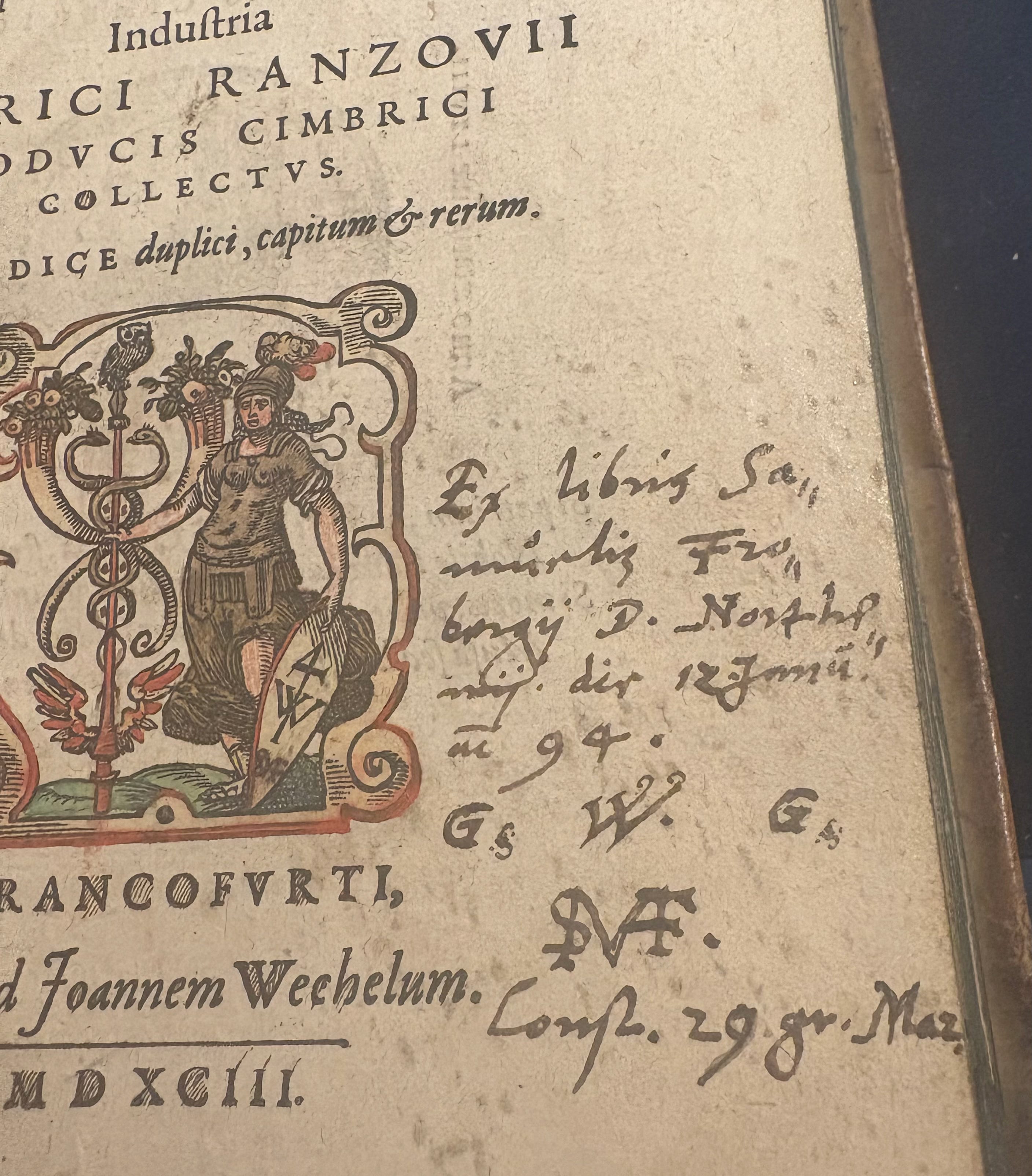
The note about his wife helped me solve a mystery about Froberg’s ownership inscription. In between his ex-libris note and the price, he gives a monogram. I see an S and F, but there are definitely some other letters in there! I think they are an A and an M—for Anna Maria, his wife. Cue the hanky. I am more used to seeing these sorts of intimate family details added to books of hours and Bibles. But of course, a book on astrological birth charts is actually a very appropriate place as well!
JWD: Ok, Rhiannon, I am grateful to know about another source on reading genitures! I’d been leaning heavily on Tony Grafton’s Cardano’s Cosmos, specifically chapter two. Finch Collins and Ben Gross both suggested the book to me when Finch wrote about the Gaurico at the former place of work.
Current Events + Personal News
JWD: My partner Aundi got me a copy of Books Will Speak Plain, which I am excited to read and ingest into my binding identification and description practice. Bonus - the book depicted on the cover is an old friend, Jane Squire’s Proposal to Determine our Longitude, which I wrote about on my now dormant tumblr blog. I also added a copy of Eric White’s Gutenberg biography to my collection as well. Excited to read both of them - one more for learning, one more for pleasure? I am sure the Miller book will be a very slow read so I can absorb and integrate some new identification and description techniques.
Alex Wingate, a PhD student at IU Bloomington, shared a piece recently published about her work on the Chymistry of Isaac Newton project, and it’s worth a read, even for non Newtonian heads! Ok, yes, Newton was into alchemy in a serious way, but more importantly, Alex’s article demonstrates the application of bibliographical methods and thinking to manuscripts and even in the digital humanities. It’s worth a read, and demonstrates that her approach (and the one of the larger project) even though it focuses on manuscript material brings fresh perspectives and information on Newton, his reading, and his books!
RK: I’m gearing up for my favorite week of the year: Bibliography Week! It’s the week when bibliophiles, bibliographers, book historians and every other type of bookish sort converge on New York City for the coldest week of the year to meet with our professional organizations, attend talks, have a little book fair, and generally make merry.
Here I must put on my Bibliographical Society of America hat and suggest that you consider joining the society if your work or interests touch on books in any way (and, if you’re reading this, I suspect they do). They provide online resources, fund conferences and publications—and membership also comes with a quarterly journal (full disclosure: the latest issue contains a short reflection by me on booksellers and the genre of the bibliographic note!). (JWD: this was so very good, and I am so glad it’s in PBSA!)
On a somewhat related note, professor and dean emertia at Simmons College, Michèle Cloonan, has a new book coming out on pioneering California bookseller Alice Millard! And if you’re in San Francisco for the book fair next month, you can hear her talk about it—courtesy of BSA and the ABAA.
Conclusion
JWD: You pointed this out yesterday, Rhiannon, but this is two years of Half Sheets! It’s such a joy to write and think with you here, and I am immensely grateful for the several hundred subscribers we have now (that’s you, learned and fair reader!). I’m always a little surprised when someone I meet for the first time mentions this little passion project of ours. We might not send something every month, but counting this issue, we’re at 15 issues, and we’ve already got the next issue in the works.
RK: My New Year’s Resolution is to be better about regular contributions! And we’ve already got one teed up for you for next month: On Curiosity! Happy New Year everybody and thanks for reading and thinking with us.
*x-files music plays*
see above.
It was the 1499 Aldus Scriptores astronomici veteres, and here’s an image of Scott Clemons’ copy of the Aratus part, via the Grolier Club library: https://grolierclub.omeka.net/items/show/184
This was a delightful read! Thank you!