
On Sophistication
or, what's in a word?


Theme
RK: Hi Jason, and everybody! Maxima mea culpa for the long hiatus. That’s all on me. This time we’re speaking On Sophistication. But not the “pinky up” kind. You know how in book condition descriptions, “good” is bad and “fine” is good? Yeah. It’s kind of like that.
This is how ABC For Book Collectors, that indispensable and occasionally snarky reference guide to bookseller lingo, defines sophisticated:
This adjective, as applied to a book, is simple a polite synonym for DOCTORED or faked-up. It would be equally appropriate to a second edition in which a first edition title-leaf had been inserted, to another from which the words second edition had been carefully erased, to a first edition RE-CASED in second edition covers, to a copy whose half-title had been supplied from another copy (MADE UP) or another edition or was in FACSIMILE. It is therefore a term very rarely found in a catalogue description except in its negative form, unsophisticated; e.g. ‘a somewhat shaken but entirely unsophisticated copy of this rare book’. First noted use, 1790.
If you are a bookseller or auction specialist, you will probably have encountered sophisticated books over the course of your work. In my role at Christie’s, it was part of a my job as a specialist to identify things like facsimile or supplied leaves, recased or remboitage bindings, etc., in order to accurately describe items for sale. Sometimes it is easy, and sometimes it is hard.
People have been sophisticating books for a long time—and not necessarily always to deceive. Of course, you want your book to be complete (especially if you are a contemporary person who just wants, you know, to read it!). In the later 18th and 19th centuries, it was trendy and not necessarily seen as dishonest or bad to “perfect” an antiquarian book by adding back in any “missing” leaves—either in facsimile, or, if they could be found, leaves from another incomplete copy or another edition. Many antiquarian books in circulation have had SOMETHING done to them over the years, particularly if they ever needed to be rebound or repaired—the perfect opportunity to clean up the leaves and try to make the volume as complete as possible. Of course, now there is a price premium on original condition, both for its rarity and its perceived superior study value.
I once catalogued a copy of the Saxton Atlas for auction. According to ESTC, this publication was not issued with a title page. My copy was in a Riviere binding, and came with a note from Riviere himself, apologizing that he couldn’t find a title page to include! Of course he couldn’t, because there isn’t one. But this perhaps gives you a sense of the attitudes about this practice in the 19th century.
JWD: I hope attitudes have changed in the intervening century! I, perhaps naively, assumed that they had, when I made a remark on Bluesky about Owen Gingerich’s practice of sophisticating or “perfecting” books in his collection, perhaps most famously in his own copy of the second edition of De Revolutionibus.
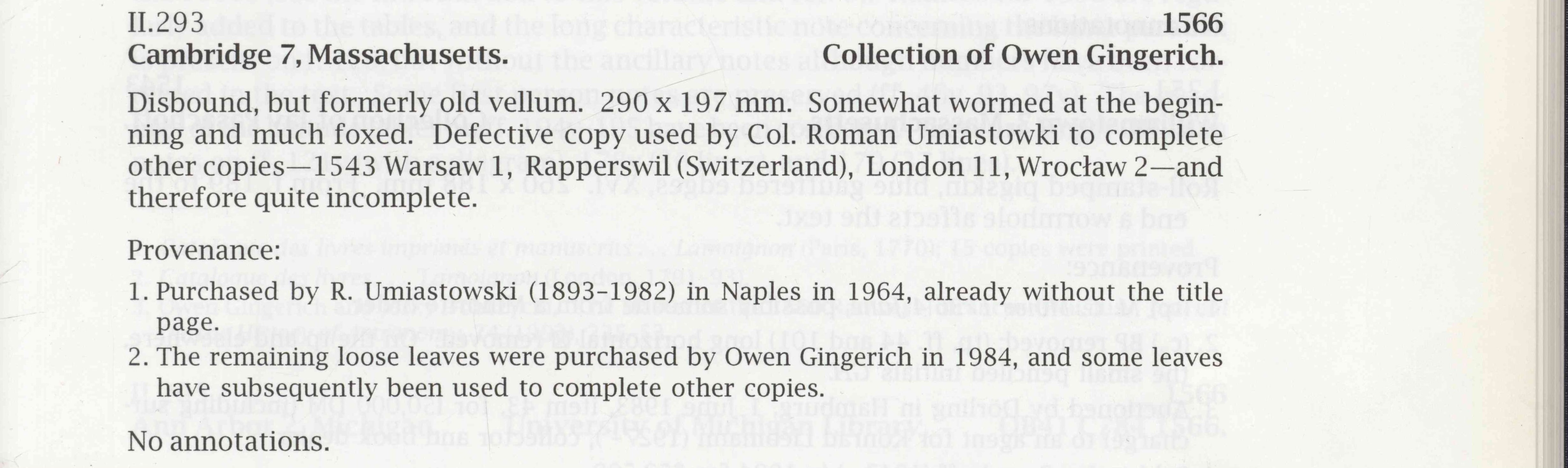
To Owen’s credit, he made no secret of this practice, and even talked about his “completion” of his copy in his magisterial census of the first and second editions of De Rev. In the days leading up to his sale earlier this year, I remarked about this on Bluesky, and was surprised at the response:
Not that this is a bad response, nor am I trying to make a judgement call on other’s opinions about sophistication. I am, rather, trying to explore the received (in my case) notion that sophistication is inherently negative. From my perspective, it certainly is, but collectors and others might have different opinions. G. Thomas Tanselle implies in this quote that our work as bibliographers is to use the evidence that a book is to help tell the story of its production and “life” after production. Willful alteration hampers that work.
Books as they were published, which frequently seemed flawed to some of their producers (including the authors of their verbal texts), are facts of history and deserve to be studied as such. But intentions are also historical facts, if sometimes more elusive, and the effort to reconstruct intentions (as in scholarly editions of authorial intended texts) is a valuable historical undertaking. (Tanselle, A Bibliographer’s Creed, point 7.)
I think about the havoc that sophisticated copies of il Saggiatore would have wreaked on the work Nick and I did on watermarks for the book. Or, well, any book with a complicated watermark situation. It seems to me that this drive for a perfected copy of a book comes from a misunderstanding of the bibliographical term ideal copy. It’s not the “best” copy, it’s the one that might (or might not) exist that most closely mirrors the intention and plans of the author. Take a look at Tanselle’s definition on p. 523 in his Descriptive Bibliography for a much better definition of the term. It really has little to do with the moral or value implications of ideal, and more to do with the book as it appeared with no following alterations. The act of sophistication, then, violates the concept of ideal copy. As ever, Bill Reese said it better than I:
Physical alteration of books is not only an issue of collation. One argument for the necessity of using original sources is the notion that the ethos of the original artifact lends an immediacy to our understanding of the text. We handle and observe first-hand the aesthetic of a place and time, and if it is unaltered, it tells us something about that place and time, providing a context to text.
William S. Reese, Collecting Early American Imprints, talk given May 15, 2000 at the Library Company of Philadelphia.
And I can’t not share this song, which was very much in my head when thinking about perfecting or sophisticating books:
Two Cool Things
JWD: I’m glad to have a book to share here that is certainly a riff on the theme of sophistication, and alteration of printed works. Earlier this year, LHL acquired a well-worn volume, comprised of 24 printed moon maps and four images of the moon’s surface. What’s remarkable about the volume are the extensive annotations in it, as well as its construction and use. Here’s a link to the catalog record, if I have your interest, and there’s a manuscript spine title: Maps Belonging to Neison’s Book on the Moon.
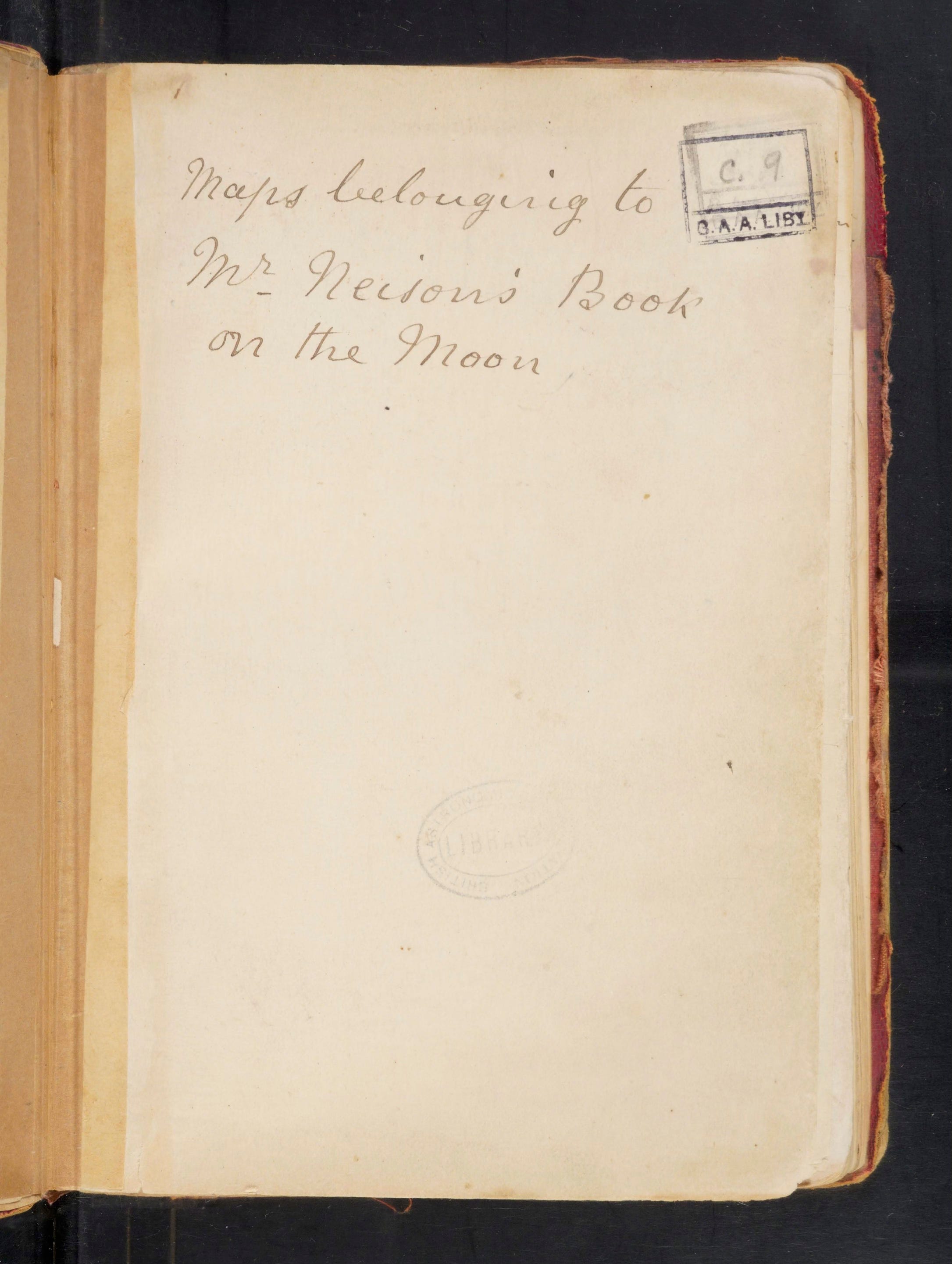
This rather gives away the plot, doesn’t it? Mary Ashley (1842-1903) wrote this in one of the front free endpapers, noting that she took the maps and plates from a copy of The Moon and the Condition and Configurations of its Surface of 1876. Thanks to the craptastic (term not in Carter) book tape on the spine, I can’t tell you much about the binding, but it seems likely Ashley had the volume bound with interleaved pages of notes about alterations she made to the maps in the book.
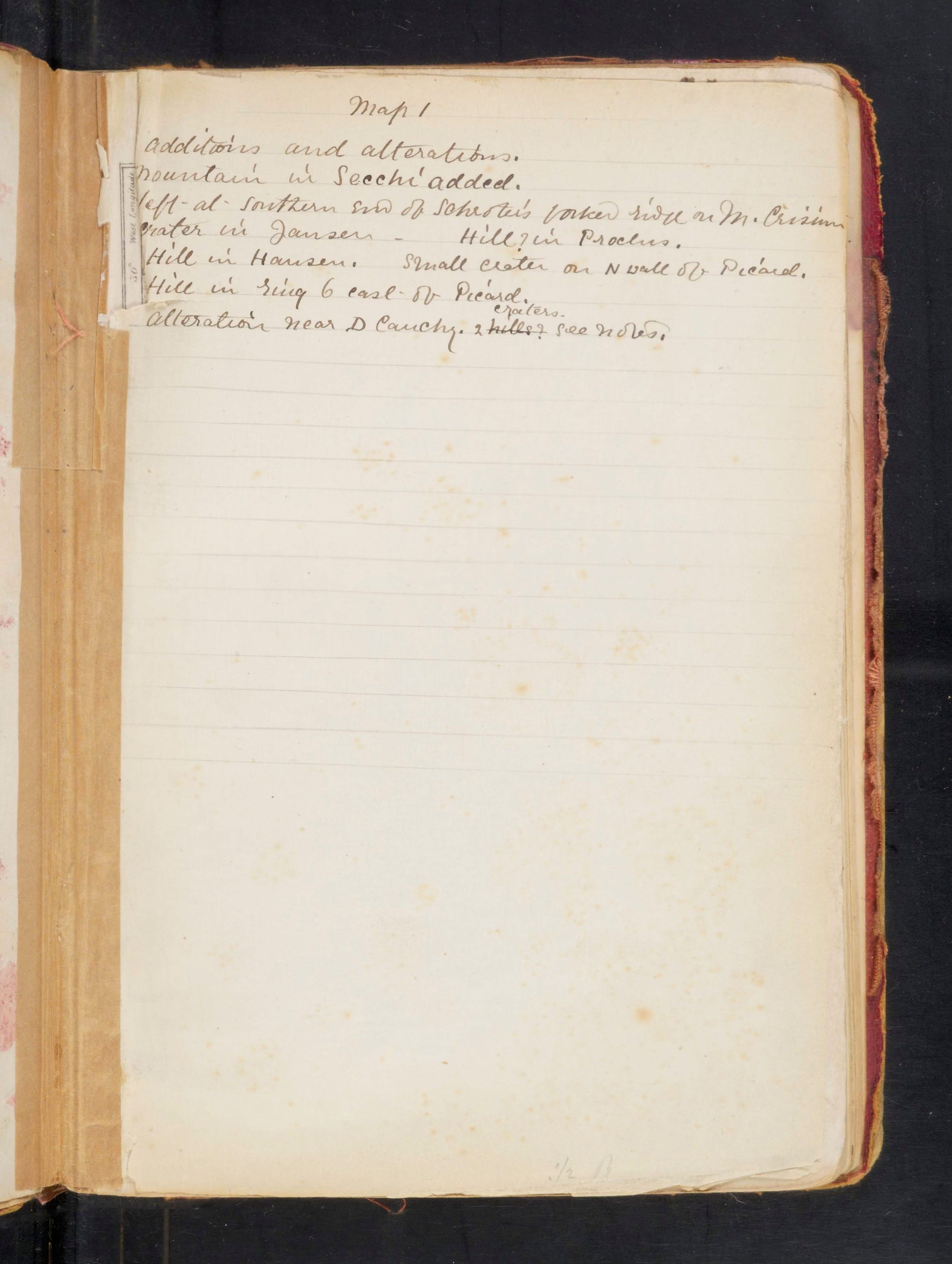
But, you might be asking yourself, why? The book, initially owned by Ashley, was later owned by Mary Adela Blagg, who were both selenographers and astronomers. Ashley and Blagg extensively annotated these plates, adding in new features and dividing the moon’s surface into distinct regions. It seems likely that this work was done by Blagg in preparation for the publication of her Collated List of Lunar Formations of 1913, also held by the Library. The publication of the Collated List enabled the International Astronomical Union to standardize the names of objects on the moon’s surface, resulting in her co-authored work of 1935, Named Lunar Formations.
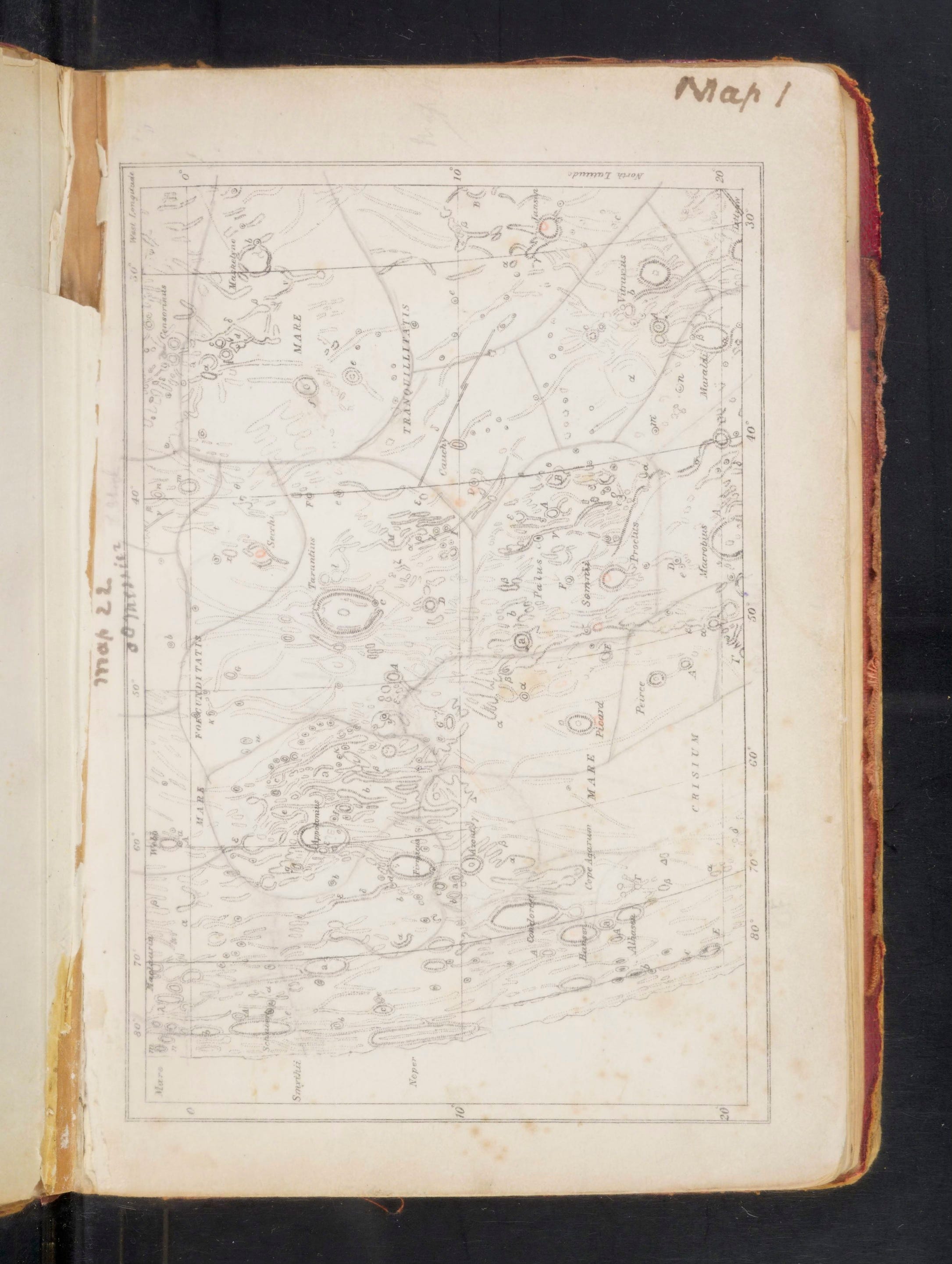
Both Blagg and Ashley also published in a rare and significant selenographical journal, the aptly named Selenographical Journal. It is likely that Ashley used this new acquisition initially as a working record of her observations in preparation for publication in that journal. I am unclear about the connection between Ashley, Blagg, and Hardcastle and the British Astronomical Association, whose stamp appears on the “title page.”
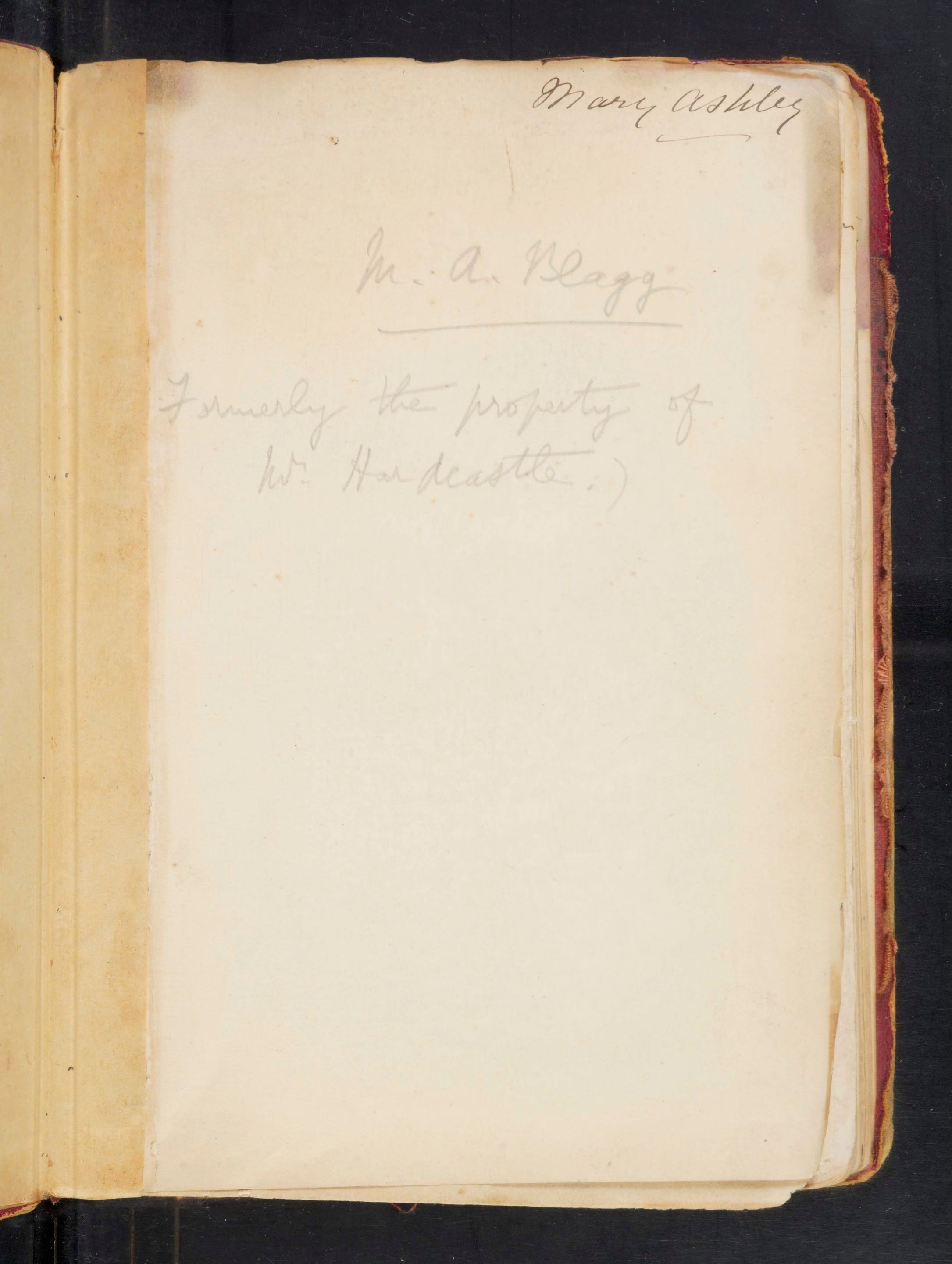
I’ll admit that it’s certainly not intentional sophistication in the way we talked about above, but it is an assembly of items from another source to fit the needs of the user. It’s also a great item that was used, and used in an important project by two of the leaders in their fields!
RK: I think you hit the nail on the head though, that everybody who sophisticates a book is doing it to better fit their needs (for better or for worse!). An alternate approach to this whole concept is “extra-illustration”—instead of adding something “missing”, past owners might gussy up their books with additional illustrations which they felt were relevant to the topic. The extreme expression of this can be found in the not-uncontroversial practice of grangerization, in which readers added prints, leaves from other books, and sometimes manuscript fragments in a scrap-book-like manner to their books. You also might find, particularly in science books, that some past person has added in an illustration or two to a book to help make it more useful. Think of it as a step beyond simple annotation.
I catalogued a book in this vein recently for a subject list on Medicine (although I’m sure it happens across genres!). Claude-Charles Pierquin de Gembloux’s 1823 Réflexions Sur Un Cas D’Hermaphrodisme Et D’Hypospadias is a discussion of “hermaphrodites” which ranges from physiology to legal issues. The author notes that intersex individuals had been attested since antiquity and that the new laws requiring the immutable sexing of infants at birth were both cruel to people who turned out to be a different sex than originally thought (they were basically forbidden from marrying, for example) and also unscientific.


This copy was a presentation from the author, and either he or the recipient had an engraving of Marie Augé by Jean Michel Moreau le Jeune from another work added to the volume. Someone also added a manuscript key to the image, presumably intended to aid the reader’s understanding of intersexuality as a medical phenomenon (there aren’t any illustrations designed to go with the original work). This isn’t sophistication, but springs from a similar impulse: take the original book and make it better/more useful/more desirable.
Current Events
JWD: In case you missed it, friends, LHL has announced our (their?) acquisition of an annotated incomplete copy of John Flamsteed’s Historia Coelestis, 1712. We acquired it at the recent sale of Owen Gingerich’s books at Christies, and I am glad that I had the opportunity to see the copy in-person about this time last year. My friend Emma-Louise Hill and I (we call ourselves the flamstans) worked closely on this - confirming that it is the only known copy of the book corrected by Flamsteed and his assistants. It’s also comprised of the sections of the book he objected to - which you can read more about at this blog post over on the LHL website. Here’s a little excerpt of the nature of the corrections:

The printed note by Halley reads “Has ptolemaeus inter informes [Leonis] censet; et congeriem stellularum, instar nebulosae inter Leonem et Ursam, ait, simpliciter πλόκαμος appelari, Hederae folium forma referentem: parte scilicet acuminata Folii Boream respiciente, et stellis h et k latera claudentibus. Bayerus autem loco Comae Spicarum fasiculum assert, absq; literis.”
[Ptolemy considers these to be among the shapeless Leo; and he says that the cluster of stars, like a nebula between Leo and Ursa, should simply be called [plokamon e.g. locks or braids of hair], referring to the shape of an Ivy leaf: namely, the pointed part of the leaf facing north, and the stars h and k closing the sides. But Bayer asserts that instead of hair there is a bundle of wheat, without letters.] This entire note is struck through, with a marginal note (again, in Crothswait’s hand) that reads “falsum est.” Here, Flamsteed via Joseph Crothswait is stating that Halley does not understand Ptolemy and has misread Bayer’s star catalog, which is correct. In his Almagest, Ptolemy describes the stars that now are identified as the Coma Berenices as a cluster of stars, like a nebula, and uses the Greek word for locks of hair for it. Halley is correct here, but his assertion that Bayer (in his Uranometria) identifies the same cluster of stars as wheat is incorrect. While Bayer uses a sheaf of wheat in plate 5, he depicts it as hair in plate 2. Bayer only identifies the stars in plate 2 as the Coma Berenices. In plate 5, he gives an explanation of the history of the identification of the star cluster.
A final note for you all - Nick Wilding let me know that Friend of the Sheets (is that what our readers are? Workshopping, open to suggestions) Paul Needham will be giving a talk at Rare Book School later this summer that should finally lay to rest the noise about the Mainz Catholicon. Paul Nash had a good contribution to this as well, but I am really keen to hear Paul’s updated argument and conclusions.
RK: Since you last heard from me, we’ve put out THREE catalogues: THE CRADLE OF ENGLISH BIBLE ILLUSTRATION, INTERVENTIONS, and MEDICINE. Check them out for some bibliographic goodness.
The McKittrick crew has been traveling all around lately—you might have seen one or two of us in Kalamazoo, Paris, New Haven, or NYC recently. But we’re sticking around town until the Boston fair in the autumn now.
Let’s Get Personal
JWD: Well, I suppose this is a good place to share two bits of news: first, I’ve left Linda Hall Library after six and a half years. It’s not a decision I made lightly, but one I needed to make. I’d be glad to chat privately about this if y’all have questions.
Lots of folks have asked what’s next for me - and I’ll share here (first) that I will be just down the road in Lawrence, Kansas, at the University of Kansas! Specifically, I am thrilled to be Associate Librarian (faculty, hired with tenure), working in the Spencer Research Library. I’ve known the director, Beth Whitaker, for a long time, and I know the Dean of Libraries, Carol Smith, via the interview process and her really positive reputation in the field. I’ll be cataloging, doing bibliography, and continuing my work on Flamsteed, Newton, and Galileo from Kansas. I am really excited, and honored to be granted tenure as a part of my hiring. I think most immediately, Emma-Louise and I will launch some articles about Flamsteed and the Historia Coelestis. More soon!
Speaking of all things Flamsteed, etc., Emma came and was the star of the final After Hours that I hosted for LHL! The recording is up, and I hope you enjoy it. Emma was great, and we got some really outstanding questions.
RK: Preparation for the book fair (and its aftermath) really threw me off the newsletter schedule, even though (thankfully) there were no major life changes for me. Immediately after the NY fair, I jetted off to Columbus, OH to give a talk for the Aldus Society—a bibliophile club based at the Thurber Center: “Aristotle, Columbus, and Other Big Mistakes that Shaped the Modern World” (I couldn’t resist talking about Columbus in Columbus!). It was not filmed unfortunately, but I’m happy to give you a private version if we ever find each other across a bar table—it was essentially a fractured fairy-tale trip through the “greats” of history of science, looking at what all the “greats” got wrong (that we don’t talk about so much). Naturally, it was a great opportunity to dunk on Aristotle and share a little bit of Platonist gospel with a captive audience, who were really lovely! In the Q&A we coined the term “paleo-errorology” to describe the study of past mistakes.
I just returned from London, where I took Dr. Nicholas Pickwoad’s course at London Rare Book School on European Book Binding (something I’ve wanted to do for a long time!). It was a really incredible introduction to what is essentially the archaeology of book bindings—an exploration of the underlying structures of early modern books and how they are built up in layers over time. I can tell it’s going to make me really annoying for a long time (hey, that’s a tabbed comb spine lining… and… ). Over the rest of the summer, I’ll be working on some upcoming articles for publication and, of course, cataloging away…
Conclusion
RK: Thanks for being a reader—it’s great to have a place to share these slightly longer form thoughts!
JWD: And for your patience waiting for this issue! We have things in motion to be back with you all next month, and we’ll be talking about bindings - I am sure you’ll be spellbound, reader…
RK: Mwahahahaha!!!!
Re: "... a manuscript spine title: Maps Belonging to Neison’s Book on the Moon." There may be a spine title, but the image posted just below this note is clearly an endleaf.