
On Incunabula
or is it incurables?


JWD: We, as a profession or group or whatever the heck we are just can’t stop talking and writing and thinking about incunables - books printed in western Europe from about 1450 through 1501. I’ll start with a sweeping (but I don’t think controversial) statement: they comprise the best studied and documented discrete corpus of printed books in existence1. There’s plenty of evidence to support this assertion - take the existence of the Incunabula Short Title Catalogue (ISTC), the Material Evidence in Incunabula (MEI) project, and the Gesamtkatalog der Wiegendrucke (GW). These are large scale, intensive projects to trace, describe, and count all known extant incunabula.
Cool. But… why should we care? Why this group of books in particular, other than the broad concept of “old=cool”? I’d argue that we study incunabula so exhaustively because much of what held true in books and printing until, say, the middle of the 19th century, was first tried, explored, and widely used (or not) in those first fifty-ish years of printing in western Europe. Take a moment and think about what we take for granted in modern books: page numbers, indices, title pages, illustrations. These were all to varying degrees innovations in early printed books.
Another benefit of this deep level of study is that we’ve generated a large enough corpus of data (using that phrase loosely) to model some interesting things - movement of woodcuts across shops, adoption of, say titlepages, and regional trends and expectations in printing. We can also make some broad statements about survival and gesture some at print runs. This incunable data, then, helps us to better understand the whole of printing in the handpress era.
RK: Incunabula comes from the Latin for “swaddling clothes” or “cradle,” which I have always found adorable.2 They are books from the infancy of printing in Europe.
When I show members of the general public 15th-century books, their most common reaction is to be amazed at what “good condition” they are in. I suppose they imagine a five hundred-year-old book must be very scruffy—but of course, that’s not true at all. Compared to the rapidly decaying products of the industrial age, incunabula—often printed on rather thick, creamy paper and sturdily sewn together, can still look quite fresh (if they’ve avoided water, fire, and rodents at least).
It is the freshness and presentness of these very old objects that is part of what really captivates me, I think. Although they have and transmit history, they are not history—they are here with us now.
My path into rare books was driven by my interest in classical transmission, so as you might imagine, the first incarnations into print of Greek and Latin literature—so different than how they appear in the Oxford Classical Texts and Cambridge Green-and-Yellows of my education—have always been a particular fascination. A watershed moment for me was in 2021, when I catalogued the early printed books in the Elaine and Alexandre P. Rosenberg Collection for auction.
An obvious point that didn’t fully hit me until then is that, of course, ancient literature was far from the only thing 15th-century printers were getting up to (indeed, not even the main thing). Medieval texts composed in the intervening millennium also needed to get into print, from famous sermon collections and the standards of scholastic philosophy to vernacular romances and scientific manuals.
Most people know about the Gutenberg Bible. But as book collectors know, you can’t have just one book. The Bible alone has a whole ecosystem of commentaries and interpretive tools to go along with it. If you’re going to read Thomas Aquinas, of course you also want some Aristotle (and all his commentaries). Add on to that all the Classical Latin favorites of the past, their commentaries, plus newly discovered ancient works brought by refugees from the Byzantine Empire, plus all the new things people were writing FOR print, and you’ve got a really vibrant and diverse world of material coming into wider circulation from many time periods.
What gets printed where and when can tell you a lot. Quick, what was the first dated book printed in Italy?3 Of course, as we all know, it was the works of Lactantius. Lactantius? A Christian Berber writer from the third-fourth centuries CE, he wasn’t a big part of my 21st-century education in classics. But he was the perfect author to help get late Medieval and Renaissance readers up to speed on the world of antiquity, presenting a pre-digested Christian perspective on the pagan literary tradition.
For me, a specialist in European printed books with a particular interest in the even further distant past, the world of incunabula is the perfect laboratory for all kinds of thinking about material texts. Something I’ve always found intriguing is that the technology of printing wasn’t exactly new. We know that China4 and Korea got to it long before Europe (and there is even evidence of medieval printing in certain European communities before Gutenberg5). Conceptually, it is not so different from other basic technologies like coin minting. It just took the right combination of historical circumstances (literacy, availability of paper, etc.) and Gutenberg’s invention of the adjustable mold to make it catch on.
Two Cool Things
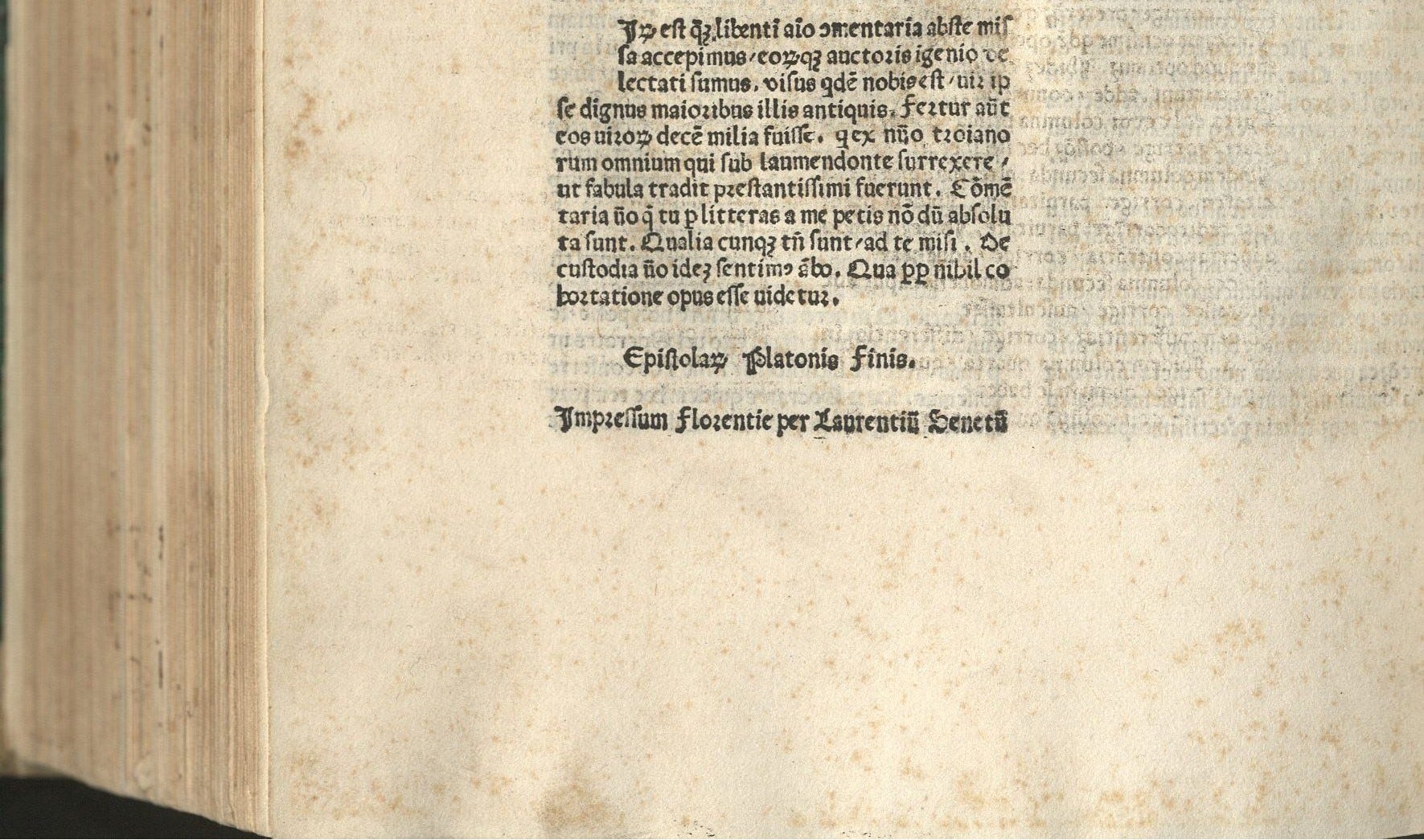
JWD: I’m starting a long term project at Spencer to inventory and better describe the Summerfield collection - germane to this issue as it contains all of the incunabula held by Spencer. Rhiannon, you and I were virtually browsing those, thanks to the ISTC, and you highlighted one in particular, which is very unremarkable at first glance - the second volume of the compiled works of Plato, ostensibly printed by Lorenzo de Alopa between 1484 and 1485. As you shared with me (and wrote about in this fire lot description) that ostensibly is where this gets interesting. Based on an extant manuscript source, parts II-V were printed by the nuns of the Convent of San Jacopo di Ripoli. The community had two printing presses, and the sisters worked as typesetters. The work of this press - and those nuns - makes this the earliest known instance of women engaged in printing work. Over 40 titles were printed in this remarkable shop, with this Plato being the last.
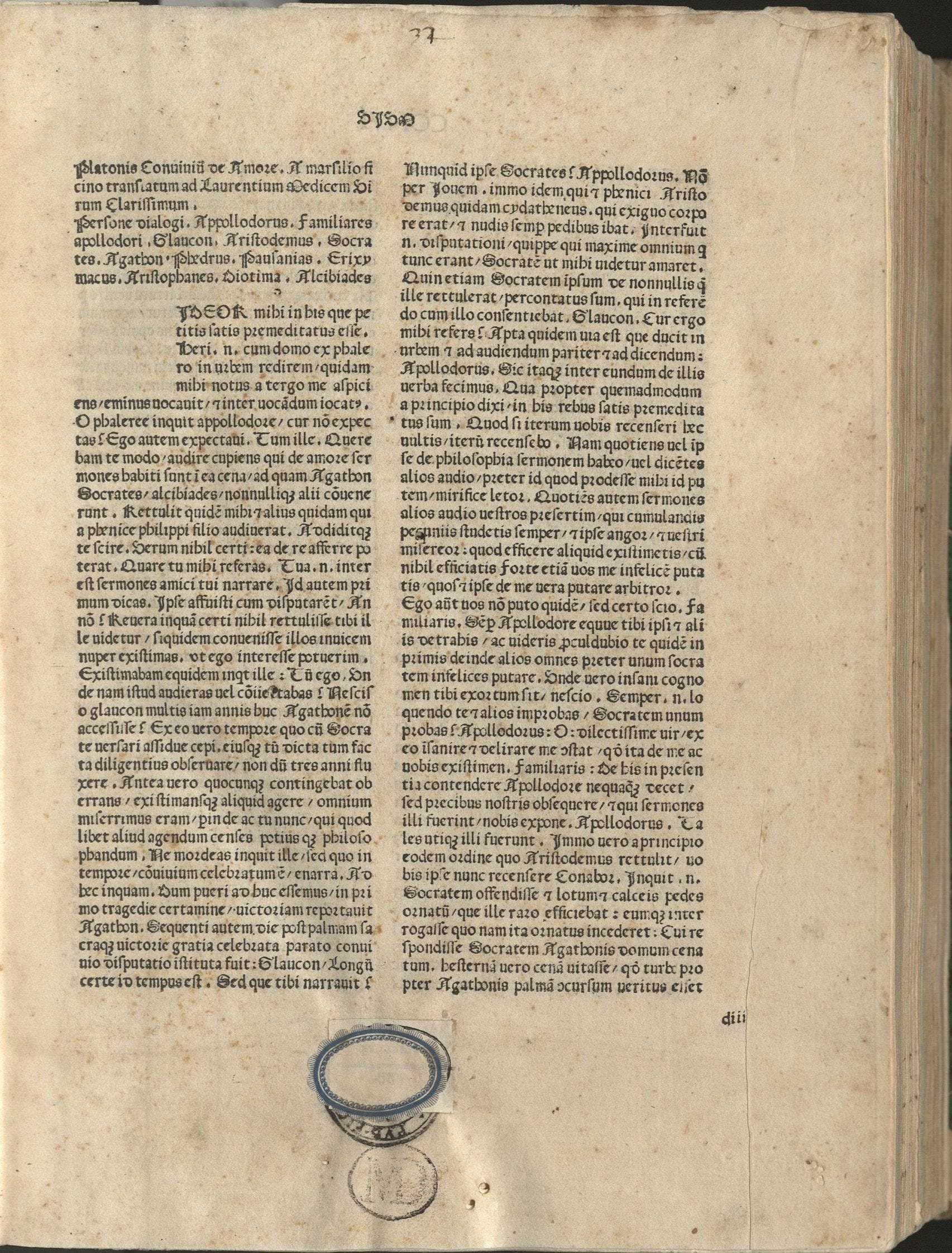
The last line of text indicates, though, that the volume was the work of… Lorenzo de Alopa - not at all a community of nuns! How, then, do we know the nuns typeset the book? Their business ledger/diario survives, now at the Biblioteca nazionale centrale in Florence, shelfmark Magliabechiano X.6.143, but not digitized (alas).
The diario has had two solid studies - the first is Helen Latham’s dissertation, and the second is Melissa Conway’s book (a revision of her dissertation). Conway says that the Plato was…
by far the largest printing job the press had ever undertaken…the commission of such a significant edition—the first translation of all the works of Plato into any Western language—underwritten by friends of Ficino himself, suggesting the press had gained a very good reputation within the influential and monied humanist circle in Florence.
RK: The Rosenberg copy of Ficino’s Plato is one of my favorite books I’ve ever sold. And it also gets at how much bibliographic investigation goes hand in hand with archival research. There is a lot to learn from the books themselves—but the documentary evidence of print shops and publishers adds a whole new dimension to our understanding of early modern print culture beyond the colophon.
And an incunabulum can be a sort of little archive of its own. That is part of what is so rewarding about doing research on these books in the flesh, where the material evidence of their creation is just as important as the texts they transmit. Where contemporary bindings survive, printed and manuscript waste inside the boards and sewing structure not only can tell us about the use of materials and relationships between printers—it sometimes preserves whole editions which are otherwise lost.
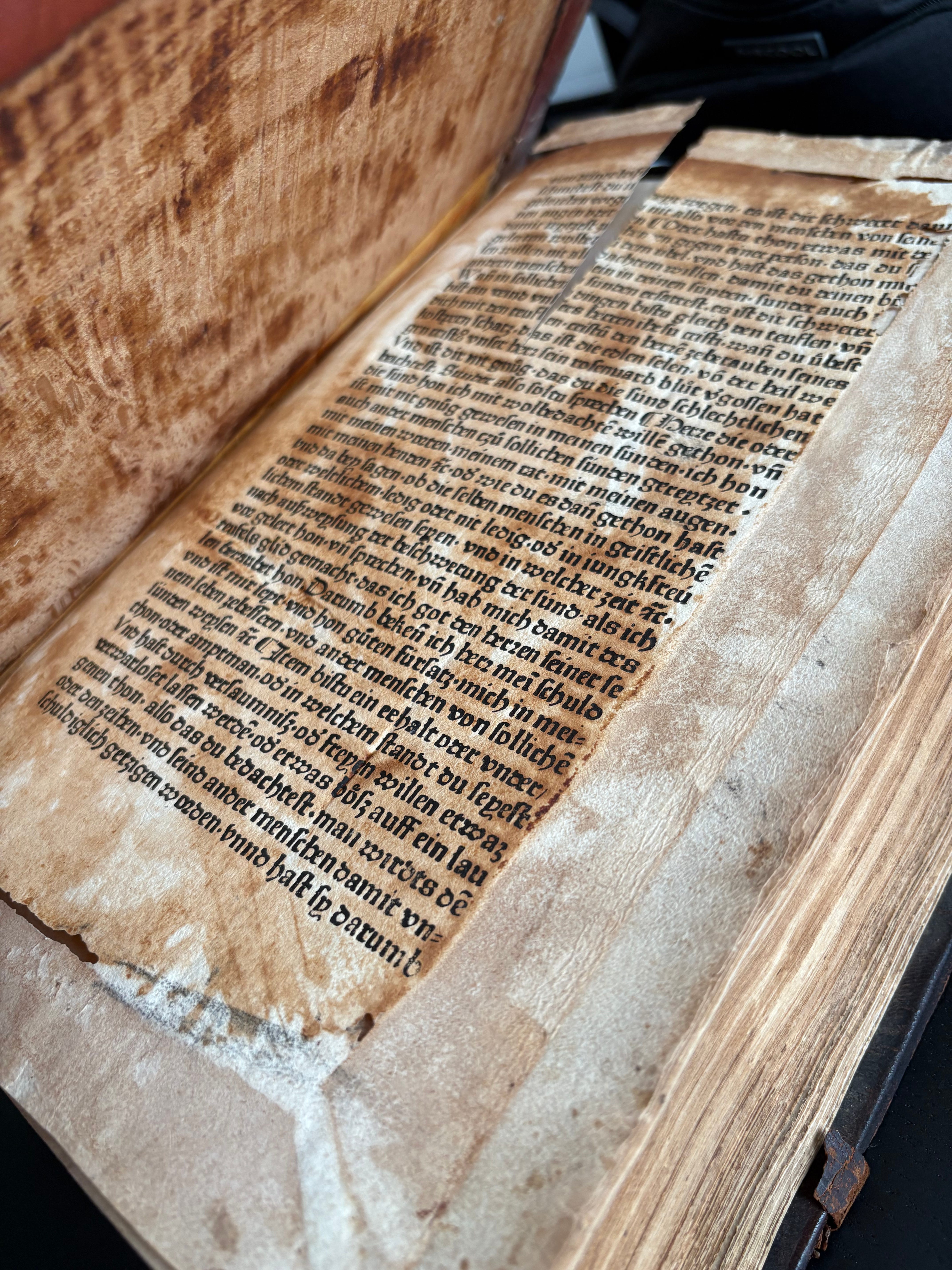
I am working on describing this book right now—Johann Zainer’s 1480 edition of Albertus of Padua’s Expositio evangeliorum. Zainer is one of my favorite 15th-century printers for his striking woodcut initials (not present in this one, alas!) and also for the interesting “mistakes” in his books which reveal things about the development of the printing process.6
This copy is still in a contemporary calf binding. The pastedowns are reused printer’s waste, printed only on one side (which the binder adhered face down, so the pastedown would appear blank). Some past person, curious about what was there, partially lifted them to reveal a treasure: the sheets are actually proof sheets of another book… printed by Johann’s brother Günther, who worked in Augsburg! I’m still working on identifying the bindery, but it was almost certainly in Augsburg—and probably not too far from Günther’s print shop.
G. Zainer proof sheets have been discovered in other bindings—Ernst Frey’s article “Makulatur aus der Presse Günther Zainers” in the 1944/9 issue of the Gutenberg Jahrbuch (still an important journal for studies of early printing!) describes a number of them, including some which provide evidence of now lost editions. My proof sheets are from ISTC is00675000, and it is possible to examine a digital facsimile of a complete copy and see where corrections were made for the finished edition. The magic of technology, from 1471 to 2025.
Current Events
JWD: One of our mutual friends, Rebecca Baumann, has launched their own substack, titled Nympho Librarian. Rebecca is a wonderful person, who I think we’re both proud to count among our friends and colleagues. They are also one of the most important collectors of (broadly speaking) “blue” pulps today. Here’s how Rebecca describes their newsletter:
This blog will primarily focus on my queer pulp collection, with other excursions into the wider worlds of sex, porn, smut, genre fiction, and various other dreadful delights. For me, collecting is meaningless without mechanisms for sharing. My hope is that as I go on my quest to read my own damn pulps that I can share what I learn along the way with you.
I heartily recommend it to you, reader, if you’re interested at all in 20th century books, countercultures, and Spicy Books!
Speaking of recent(ish) events with a focus on incunabula, Eric White (Scheide Library, Princeton), published a new biography of Johannes Gutenberg, titled Johannes Gutenberg: A Biography in Books. I’ve not read it yet (have you, RK? RK: Not yet but let’s talk about how it’s a part of Reaktion’s Medieval Lives series and not Renaissance lives! I approve—but readers, share your thoughts in the comments!) but it came across the Bluesky transom while writing this issue. I can think of few people better qualified to talk about the life (and what little we know of that life) than Eric. If you’re interested to do more, Princeton did a nice interview with him, which you can head over to here. It’s in my book wishlist (and might be nice reading for the Denmark travel).
Also coming over the social media transom is an upcoming event at the Schoenberg Institute at Penn, where Michael Zellman-Rohrer is going to talk about his work at Penn on astronomical and astrological manuscripts. It’s titled Pages of Stars: Case Studies in the History of the Astral Sciences from the Lawrence J. Schoenberg Collection. (How do we feel about the term astral sciences, folks? Doesn’t seem to be the best, at least in my mind.) Love that we’re still doing virtual (or at least live-streamed) lectures.
RK: Do we have any Philadelphian readers? If you’re out there, I have to make a plug for Philobiblon—our local bibliophile social club. We’re kicking off our 2025-26 season this week with a tour to the American Philosophical Society, and then monthly bookish lectures at the Rosenbach. If you’re interested in becoming a member, hit me up!
Let’s Get Personal
A dash of personal news
JWD: My kind colleagues here at Spencer do new staff profiles, and mine went live late in August. I wrote 2k words, but uh didnt see the limit of 1k words, so here it is, in abbreviated format! I talk about St. Jerome, bibliography, and a few other things, I hope you enjoy reading it.
As I tend to do, I want to stretch the theme of this issue. I finished my first bibliographical notebook in mid-August, which prompted a bit of reflection on my part. I began the entries in December of 2023, shortly after Paul’s visit with Nick to my former place of work. I watched them using notebooks to record their observations of books, and chatted about this with you, Rhiannon. It’s been a rewarding process, and now (a year and a half later) I can look back on the things I’ve cataloged, and the ways in which I’ve grown as a bibliographer. Here’s the table of contents for this first volume:
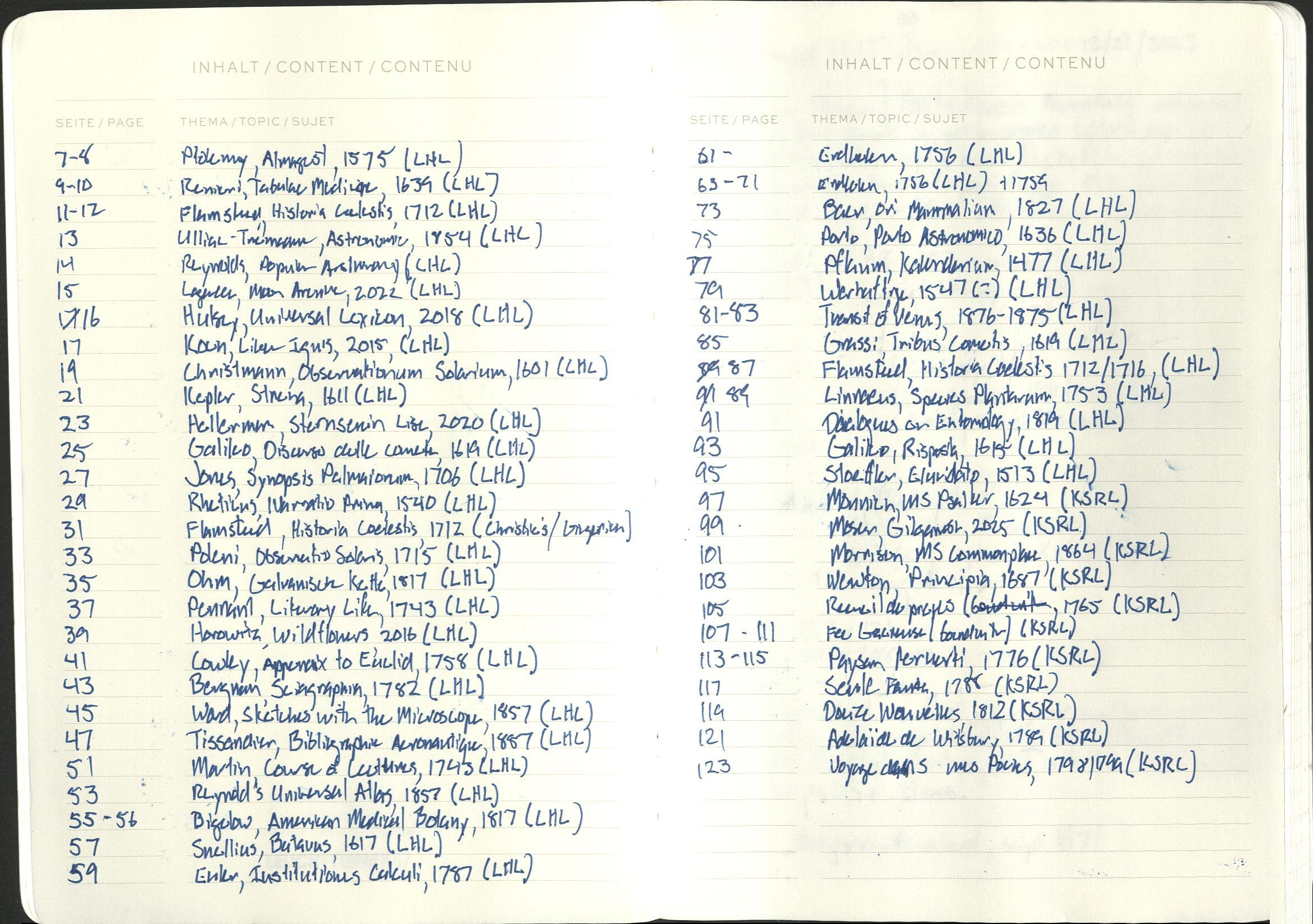
Those early descriptions are, for me, my bibliographical incunables. I remember having Tanselle’s Descriptive Bibliography open at my desk, trying to unpack his methods. The act of describing - of using my notebook - has cemented bibliographical skills in my memory, and has allowed for consistency in my descriptions.
It’s also remarkable how much I’ve added to my bibliographical toolkit in this time. I began with entries that generally mimic my work as a cataloger - title page transcription/quasi facsimile, format, collation, and DCRMB compliant pagination, with a brief binding description and a few other notes. My final books, done here at KSRL, have incorporated signature statements, Bowers pagination, STCNF fingerprinting, and line counts. While it’s not a full bibliographical description with paper description, etc, as I’ve done for a few books (looking at you, 1712 Historia Coelestis), this method of description keeps me in practice with what I think are core bibliographical tools and methods. The recent return of my colleague, Adrienne, from Whitesell’s RBS des bib course has taught me a lot I didn’t know, and added more depth to my examinations. I feel grateful to always be learning and challenging myself in areas that I derive deep satisfaction from. Anyhow, don’t “at me” but here is an early description, and one I did recently, just so you can see some growth and how I do what I do:


As you read this, I’ll be taking my new notebook (appropriately KU blue) and tools with me to Denmark, for the AIB Congress in Copenhagen. It’s a full (and exciting) program - but I’ll also be sneaking out one day to visit the Royal Danish Library to see their Sidereus Nuncius and their 1725 Historia Coelestis. Nick Wilding and Paul Needham have already “visited” the former, but neither Emma Louise nor I have visited the latter - hoping this Danish copy has some good evidence, etc, inside!
My colleague, Whitney Baker, our head conservator for the KU Libraries, recently published a piece in the newest volume of Julia Baker’s series, Suave Mechanicals, specifically volume 9 - her chapter is titled “Keeping the Books: Italian Stationery Bindings in the Rubinstein Collection of the Orsetti Family Business Archive at the University of Kansas. Whitney used a recent sabbatical to look closely at a collection here at Spencer - of the financial ledgers of the Orsetti family, specifically in and near Lucca, in modern-day Italy. She did a great job of summarizing the collection, connecting it to the bookkeeping instructions of Luca Pacioli (there’s your incunable connection) and the different dimensions of the ledgers and notebooks. More specifically, Whitney examined the bindings and structures of the collection, which is outstanding stuff. Strongly recommended. Also, an amazing collection here at Spencer! And to have such a great group of scholars to count among my colleagues!
RK: At the end of the month, I’m off to Italy for a long awaited vacation (and the wedding of a very dear friend). On my to-do list: visit Ötzi the Ice Man in Bolzano, spend a few days forest bathing (and pool bathing) in the Dolomites, and a long weekend in Florence vibing with the ghosts of Marsilio Ficino and the Renaissance Platonists. Between now and then, I have a few writing projects to knuckle down on… wish me luck!
But I am happy to share here a FINISHED thing with you—my latest catalogue, Uncovering Antiquity. I selected thirty books which are all about the work of recovering the culture, history, and literature of the Ancient Greek and Roman worlds: editing and translating manuscripts, archaeology, numismatics, inscriptions, research libraries… from the first century to the 19th. It was a labor of love and I hope you enjoy reading it.
Conclusion
RK: At the end of the preface to Margaret Stillwell’s Incunabula and Americana, she writes that
“As for incunabula, it has been truthfully said that a final word on the beginnings of printing cannot be written until the after the completed publication of the Gesamtkatalog der Wiegendrucke. It has also been said, with possibly some degree of truth, that womankind enjoys a final word. If one were to wait, however, the necessary twelve to fifteen years in a state of suspended animation, who knows if in the end speech itself might not be lacking? I am offering therefore an intermediary word, for there is much to be learned and much still to be said in these years of pleasant waiting.”
That was 1930, and GW is in 2025 an ever expanding resource. So much for twelve to fifteen years! There is so much yet to discover and learn even about a category of book that is one of the best studied; all our words are merely intermediary still.
We are working on a mid-month treat for you… stay tuned! And as always, thanks for reading!
So, I think I read this somewhere once, and I asked Paul Needham and John McQuillen about it, and it didn’t ring a bell with them either - if you, dear reader, remember where I might’ve seen this, please say so!
Incunabula is the Latin plural, while incunabulum is the singular—although I think the English “incunable” gets used more in the singular than the Latin. There are also “post-incunables” and something at my workplace we call “uncunables”, but those must wait for a later issue.
The sequence of qualifying adjectives following “first” being, of course, a classic of bookseller prose style… but you’ll see it a lot in incunabula scholarship too, as there are so many different kinds of firsts in play.
An exhibition I worked on at the Getty displayed the Diamond Sutra on loan from the British Library: the oldest dated complete printed book (that we know of).
Check out Kristina Richardson’s Roma in the Medieval Islamic World: Literacy, Culture and History (2021) for more on this interesting history.
You can read more on this in Claire Bolton’s 2016 monograph, The Fifteenth-century Printing Practices of Johann Zainer.