
On Bindings
we were bound to talk about them sometime...


Theme
JWD: I’m all in knots to talk about bindings this issue. How many binding-related puns can we put in one issue? We’ll see! The binding of a book is usually the first thing we see and interact with when we pick a book up. It has a really core function - protecting (and organizing) the material within. It’s the cover/dust jacket that first brings my eye to a book when I’m book shopping, and it also can draw my eye when I’m in the stacks here at Spencer. But, a binding (as Rhiannon learned from Dr. Pickwoad) means more than just the covers of a book. Since Rhiannon started with Carter last time, let’s start with Glaister, in the definition for bookbinding:
The hand or machine processes of fastening together the printed sheets of a work and enclosing them within a protecting cover.
Ok, not too bad. I will add that the Glaister definition follows (with illustrations) for FOUR ADDITIONAL PAGES. So, it’s not just the covers of a book, but the actual structures of assembly of the signatures/quires that comprise the binding - and these things, the bindings, the decoration, the endpapers/pastedowns, and the binding structure itself - can illuminate the life of a book. It’s yet another reminder of why I like books and this work so much - that the things that seem quotidian and unimportant at first glance can yield significant and interesting data and evidence if you know a bit about construction and materials.
RK: One of my major takeaways from the European bindings class at London Rare Book School is that each binding is its own archaeological site: leaving layers of material evidence on the book which trace its life through owners and centuries. As someone who got their start in archaeology, I find this approach very appealing! It has changed the way I look at every book.
Decadent jeweled bindings, or those with elaborate morocco inlays or tooling suck up a lot of the attention (and scholarship!) on historical book bindings. But (almost) every book has a binding, and most are not fancy. And if you’re describing the book—you need to know how to interpret it. One of the problems in this arena is a lack of standardized vocabulary for all the different aspects of a binding, from the sewing to the covers. In fact, it was disturbing to realize in class how little we really know about the bindings on most early books.
So much evidence has been destroyed through rebinding, and the information that still exists is often obscured in catalogue records. How many catalogues actually provide detailed binding descriptions? On top of that, a lot of what we think we know is probably wrong. It is really hard to tell for certain what animal a skin comes from, for instance, but we still throw out “calf” and “sheep” fairly casually in descriptions. For communication purposes, this works—people basically know what to expect when something is called sheep or calf. Currently I’m processing the revelation that are a lot of things I’ve thought of as calf that are probably actually sheep. Without a DNA test, sometimes you can’t tell at all! And goat and sheep are basically the same animal genetically!
Dr. Nicholas Pickwoad has been working his whole career to develop standard terminology for bindings in his amazing project, Ligatus, and teaches classes every summer to produce more field agents in the war for accurate binding knowledge. I really recommend that everyone who describes books for a living take one of his classes if you can! Ligatus was a little unintuitive for me at first, but you can access its wealth of information by starting at the alphabetical index and finding the “big category” you are looking for something in (in my case just now, fastenings). Click through, and you’ll see the subcategories of different types, and you can keep drilling down until you find the exact thing you’re looking at (for me, loop and knot fastenings).
Everything from the stitch patterns, methods of attaching endleaves, and how ties are sewn into a cover to types of wood used for boards, forms of sewing support, and more can help trace the origin and movement of a book through time—if you know what to look for. I was taught at the beginning of my career that books were generally sold in sheets, and then bound up by their first owners. This is not untrue, but books sometimes WERE sold bound, or sewn but not bound, or stitched in a temporary wrapper that might later be replaced (perhaps in a different country from where it was stitched!). If this seems overwhelming, you have an idea what the class was like. But I also feel excited about all the possibilities there are to learn more from the materiality of early books.
JWD: I am pleased to say I am a user of the Ligatus vocabulary, but have not yet had the benefit of Dr. Pickwoad’s class. I want to stretch this concept of bindings a bit further than the physical concept. One of the things that fascinates me (and vexed me as a cataloger early on) is that books contain information and embody information. This is a classic concept in cataloging (and I hope librarianship too) - is versus about. So many people - rightly - are engaging with the about-ness of books. The plot, the narrative, the endnotes, &c &c. Books are, at their core, a device for information storage and to some extent information retrieval. But, as I hope our kind readers know, books are also artifacts of material value and information (as you so wonderfully call them, Rhiannon, “its own archaeological site: leaving layers of material evidence on the book which trace its life through owners and centuries” - so a book, then, binds together the concepts of is-ness and about-ness. As ever, Tom Tanselle said it far better than I, in page 5 of his Descriptive Bibliography:
We regard it as perfectly normal that people write verbal accounts of the physical properties of paintings and drawings, buildings and sculptures, vases and goblets. Because these works of art and craft use physical media, any comments on their physical characteristics are comments on their artistry as well and are thus a form of art criticism. Books, however, are not as commonly approached in physical terms as constituents of material culture, since they exist largely for the purpose of transmitting verbal (or musical or choreographic) texts; and many persons who wish to read and appreciate those texts do not consider the physical aspects of books relevant to their concerns.
Thinking about it now, I do wonder if that concept - the binding together of the abstract with the real - drew me to librarianship, and then on to bibliography. I, in turn, am thankful to be bound to this engaging and endlessly fun work.
RK: Jason, don’t even get me started on this one… someday we can do an issue On Platonic Bibliography and I can really let loose. But of course for me too, the tension between the idea and the thing is a big part of the appeal of rare books and bibliography.
I was first introduced to this idea as an undergraduate studying Medieval Literature. Donald Howard’s The Idea of the Canterbury Tales (1974) has an interesting discussion of the opposing concepts of bookness and voiceness:
“From one point of view the book was an object of veneration, an objet d’art, a relic, a collector’s item, a thing with dignity, magic, the power to inspire awe. The Bible was “the book,” and both memory and nature were sometimes figured as a book. To own a book, a good book on vellum with pictures and colors, was to own something expensive and gorgeous, the work of many skilled hands … is it any wonder the voracious book collector Richard de Bury was accused of avarice by his detractors? That is bookness: to almost everyone the book was not a quotidian household object but a rarity. And just for that reason almost everyone’s experience of a book was chiefly the experience of seeing the precious object at a distance on a lectern and hearing someone read aloud from it. The book recorded the language of a spoken voice so that it could be spoken again, ‘rehearsed.’ This quality, voiceness, is what people want to illustrate when they reproduce the famous frontispiece from an early fifteenth-century manuscript of Troilus showing Chaucer reading aloud to the court. To have the author himself read his own work aloud is always interesting, even now; but voiceness means that the voice is infinitely reproducible—a book can generate untold readings or performances.”
The fact is, of course, that that the material trappings of the “ideas” in a book (its bookness) are certainly relevant to our study of those ideas. Who was the book for, and who read it? Who paid for it? How did they read it? Bindings can tell you a lot about the social relationships glued together by the material book and its intellectual contents. A velvet presentation copy says something very different from re-used waste paper wrappers.
Two Cool Things
JWD: About a year ago, my partner Aundi and I went to visit her son in Dublin at Trinity College. Shockingly (maybe?) we skipped the Long Room and the Book of Kells, but got up to some other bookish activities - Marsh’s Library and visiting the studio of Jamie Murphy at his Salvage Press (and he got us all pints and toasties). The bookish highlight for me, and maybe one of the most moving things I’ve seen in some time, were a group of objects at the National Museum of Ireland: their collection of cumdach, special bindings designed to hold books with great spiritual significance. The thing that struck me most was that these shrines, (I think of them almost as reliquaries, since cumdach could also hold corporeal or other realia items associated with saints) were designed to remain closed! This, to me, seems to be the logical conclusion of our topic - a binding designed solely to house and protect the item within.
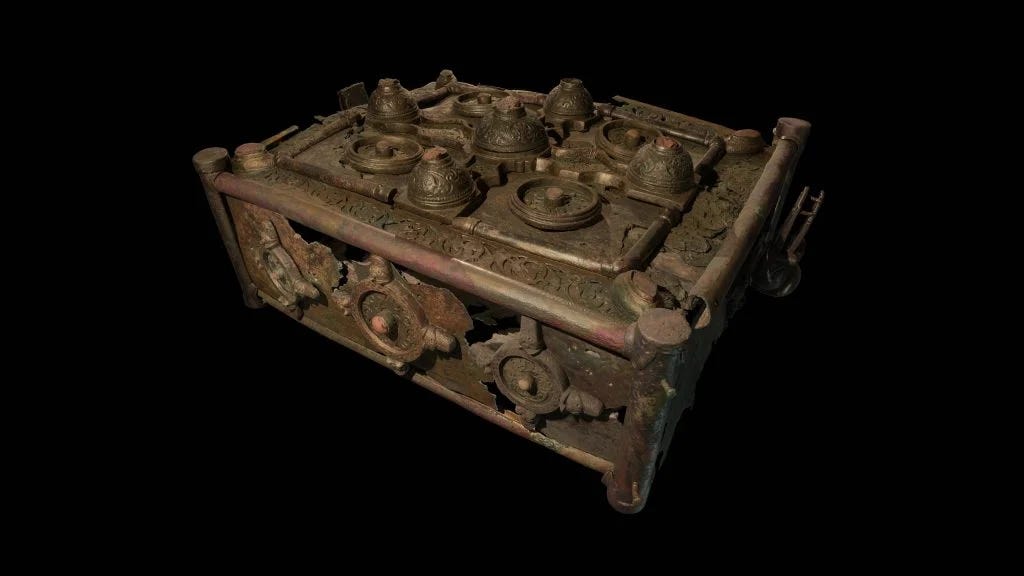
If wikipedia is to be believed, there are eight surviving cumdach, seven of which are in the National Museum, and most of those were on display. The one that stayed in my mind was the Lough Kinale Book Shrine, which is the oldest cumdach extant, and contained a currently unknown manuscript, production of which would have predated the shrine’s creation in the late 8th or early 9th centuries, and would likely have been associated with a saint through either creation or use. All of the rest are missals, gospels, or psalters. Even the famous Book of Kells had a cumdach!
To my eye, the most striking surviving shrine is the one associated with the Stowe Missal, which thankfully survives. The shrine for that missal is in the collections of the National Museum of Ireland, but I could not find good images of it on their website. Fortunately for us, the Met Museum recently(ish) made many of their images open access, and they’ve photographed their replica of the shrine, so I don’t have to leave it to your imagination:
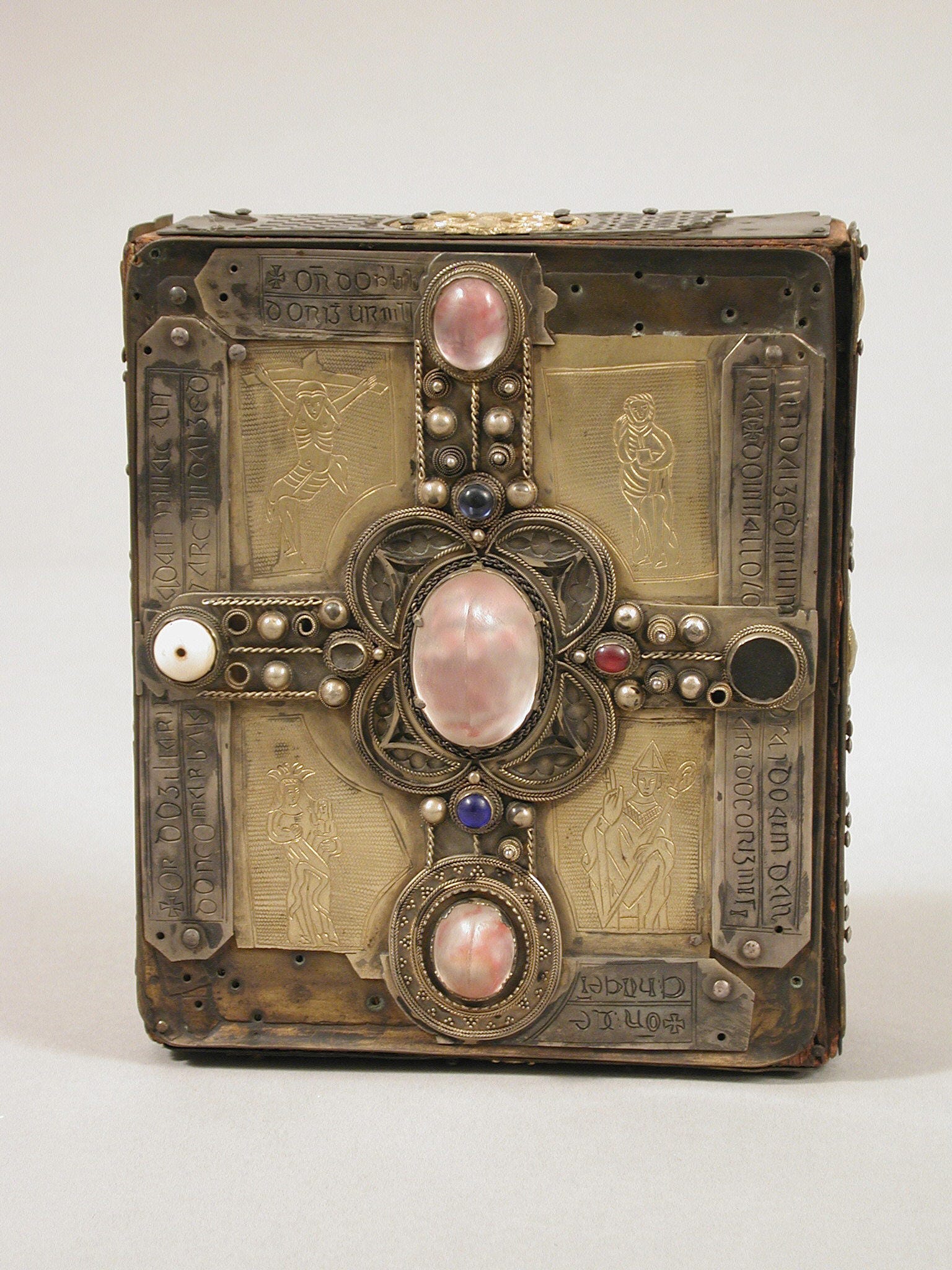
It strikes me that the book that was contained inside was a missal - a book for a priest celebrating mass. It was not a finger, or a bone, or one of the infinite parts of the “true cross” that seem to be everywhere. Inside was an object that was practical - beautiful, yes, but intended to assist the celebrant in saying mass over 1,000 years ago. Based on my reading I’m not sure why this missal in particular became a relic, but it was placed in the cumdach about 200 years after its creation. Interestingly, the binding of the manuscript is, well, a bit mundane, but why wouldn’t it be, with a jewelled show-stopper of a shrine around it?
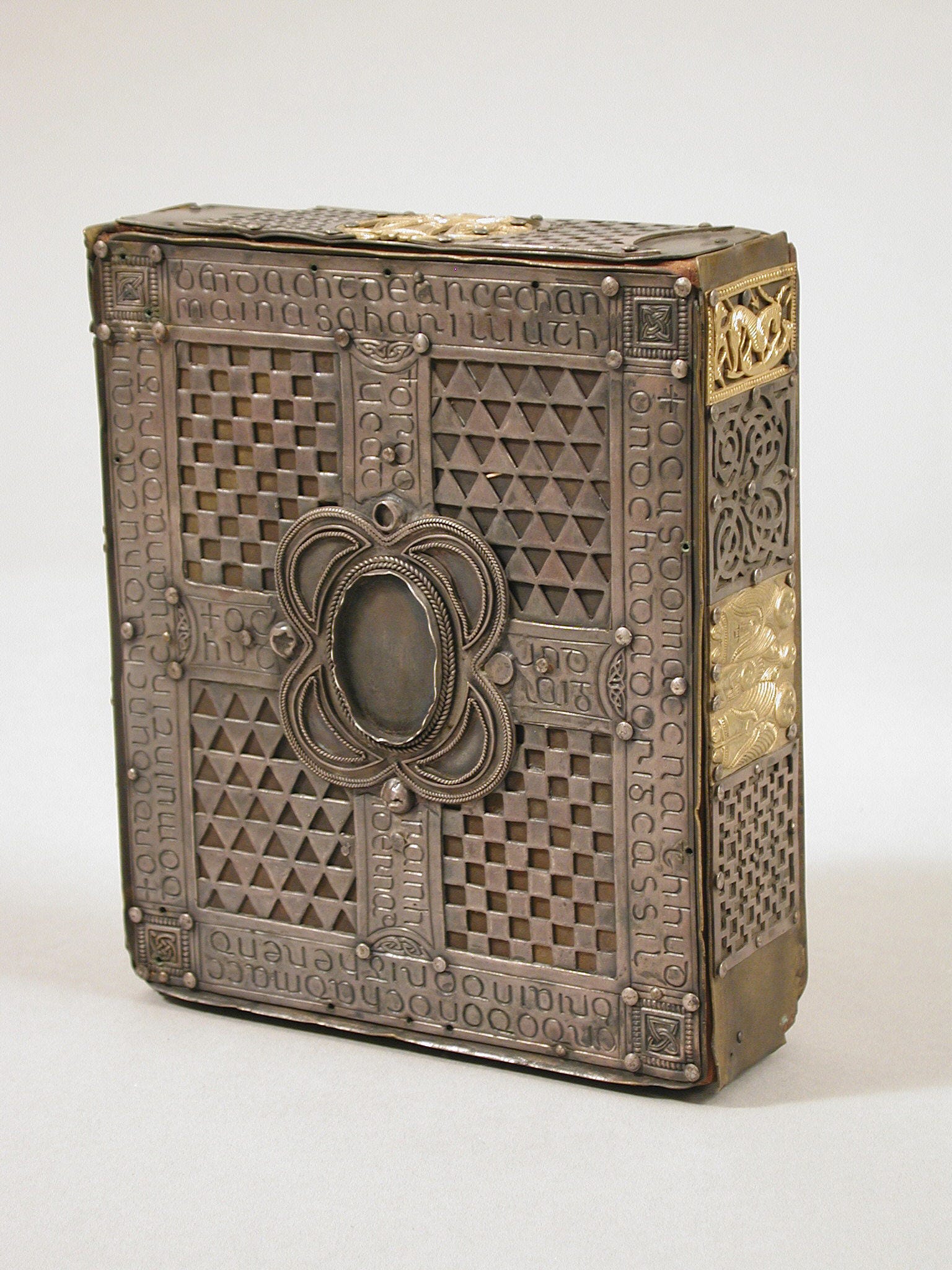
These shrines seem like the most binding a binding can be to me - so ornate and protective that one cannot even really use the book or manuscript within, all the more remarkable because the manuscripts within were usually made for practical and utilitarian purposes.
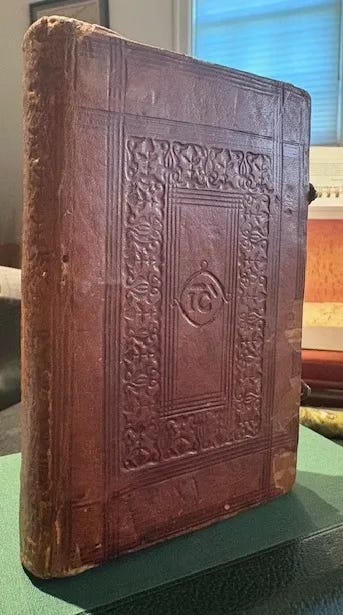
RK: I thought this would be the perfect opportunity to talk about a type of binding I’ve been attracted to for some time, but only recently gained the vocabulary to discuss in a meaningful way. If you spend time in the world of early books, you might have heard or seen the term alla greca binding1 bandied about in descriptions. But what exactly is that? A fancy term for “bound in the Greek Style,” these bindings show up on especially (but not only2) Italian books in the Renaissance. Humanists felt that a Byzantine, or “eastern”, style of binding was appropriate for their lovely new editions of the ancient Greek classics. They have a distinctive look, with smooth rounded spines, thick boards, and prominent endcaps.
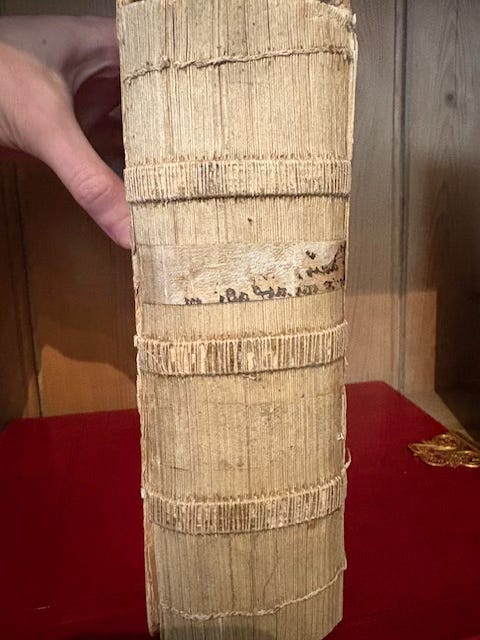
Western European books bound in this period often have raised bands on the spine, which correspond to the sewing supports which help hold the whole structure together (see image above). Alla greca bindings eschew these supports and rely on the gatherings just being sewn to each other. Because of this, they have beefed up endbands, which are protected by extensions of the board. This unusual shape, along with the elegant rounded spines, became a style point saying: I am a sexy humanist with sexy knowledge of my sexy Greek books.


It’s not uncommon to see 15th and 16th century works of ancient Greek literature bound this way. This book in our stock is a little different, however—it’s an [h]irmologion, which is a type of Eastern Orthodox liturgical book containing chants used in church services. It was actually for Greek people rather than humanists adopting a Greek affectation. This edition was produced by the Venetian printer Giacomo Leoncini, using the types of the Greek printer Andrea Kunadis. Some copies, like this one, were dispersed and used by Greek communities in the Veneto. Others were destined for Istanbul. Alla greca bindings are a case where the form is certainly related to the content! But not always in the same way.
Current Events
JWD: Rare Book School is on a lecture roll this summer, it seems, and we are all the beneficiaries of that! Rhiannon, I remember sitting in the audience at the Armory last year to watch Mark McConnell’s talk with you about the business decisions of the Plantin press as to print run, formats, and profits for the press. It’s interesting work, undertaken by someone with a different background than others that have looked at this, and I think his work has the potential to animate and inform our thinking about print runs for editions, as well as the choice of formats for printing of early modern work. I am not the person to stitch this work together into something approaching broader generalizations on those topics, but I hope that by highlighting it here among friends, it might bring together like minded folks better equipped than I do to that work?
RBS hosted a second lecture last week, this one on a very different topic. Subscribers to the ex libris email list will be all to familiar with the recent disagreements about the printing of the Mainz Catholicon (ISTC ib00020000) - whether it was printed from standing type, wood, or two line slugs, almost like a very primitive Linotype machine.
Paul’s talk was outstanding - thoughtfully and extensively illustrated, clearly argued, generous, and deeply erudite. As he does, Paul looked closely at the material evidence in front of him and made logical arguments about production from that evidence. He presented an account of the scholarship of the Catholicon - beginning with work on the paper and watermarks in the early 20th century, and added in his own seminal work on the book in the early 1980’s in PBSA. He also discussed Lotte Hellinga’s later work, as well as the recent work of Farley Katz. Paul (unless new evidence arises, as he said) definitively answered the question of how the Catholicon was printed, and how that explains the unusual printed evidence in the text. In short, the answer was nailheads.
Working with Eric White and Nick Wilding, Paul was able to determine the nature of what he initially called “blobs” in printings of the book on later paper stocks. They are not blobs but are, instead, deep impressions of nailheads. Nails? In a press? His theory is that the two line slugs were likely thin and mounted on wood with an adhesive, and during the three printings of the book, those slugs began to pull away from the wood. The printers simply nailed them down and moved on! It’s the presence of these nailheads that “put the nail in the coffin” of the other theories.
Thankfully, Princeton has some really amazing equipment that allowed them to determine the depth of the impression of the nailheads, and the depth of that impression (significantly deeper than that of the characters) bore out the nailhead theory, as do the appearance of several “fallen” nails in the printed text.
Anyhow, I’d strongly recommend your watching the talk (above), since Paul is far better acquainted with his own work than my poor attempt!
One more item of note, readers - it’s been a busy month in the republic of books! John McQuillen, Associate Curator of Books at the Morgan (other than having a fire Instagram) recently shared the chapter he wrote about the Pierpont Morgan Library’s Gutenberg Bibles in a Brill volume. It’s a really great chapter, filled with provenance, connections, and the deep looking that we love around here. A small excerpt, from p. 208 to whet your appetite:
Most scholarly articles rightly take a synchronic stance when elucidating the history of text/book/object at a specific point in time, and yet the book itself is the complete string of these synchronic movements, from creation through all points of reception. Thus, this article endeavours to understand each copy of the Morgan’s three Gutenberg Bibles through a series of temporal analyses as diachronic objects.
Let’s Get Personal
RK: I turned 36 last week, so I’ve been reflecting a lot on the past year. I can’t believe I’ve been in Philadelphia (and a “real” bookseller) for over a year now. I still feel like I’m settling in to this new life, but some progress has been made. My garden is full of roses and I’m just now putting the finishing touches on a catalogue devoted to a topic very close to my heart: the revival of Classical antiquity. Rather than just fancy copies of the classics in print, the books—many of which I bought—show the actual WORK of recovering ancient culture and making it accessible. I can’t wait to share it with you!
I finally finished reading the novel Q, an epic set during of the Reformation involving the Peasant’s Revolt, the Siege of Munster, Dutch free love cults, bank heists, Papal intrigue, and illicit publishing and book distribution. Originally written in Italian by an anonymous author collective going by the name of “Luther Blissett”, the English translation is readily available and I definitely recommend it. Next up: H.P. Kraus’s A Rare Book Saga, which has been on my list for a long time. I’ve heard mixed reviews, but it seems like a necessity at this point and so far, I must say, I’m finding it surprisingly charming.
JWD: Well, it’s been a bit complicated, but Aundi and I are off to Copenhagen in early September for the 2025 congress of the Association International de Bibliophile! The program looks great, and I’ll do a bit of my own research while I am there on Sidereus. If you’re going, please, please say hello! It will be my first time attending.
Since you opened the door, RK, I’ll add I just finished Native Nations, which was excellent, and I am currently reading the 15th Inspector Montalbano book.
Conclusion
RK: Look at that! I’m back on the monthly newsletter wagon. Hopefully I can keep it up…
JWD: I have faith in you, RK! And I know we already have some good things cooking for our next issue, which seems especially apt given the recent discourse about the Catholicon - we’ll be chatting about the oldest known printed western books - incunables!
The Ligatus dictionary has an entry under Greek bindings: https://lob.is.ed.ac.uk/concept/1357
See Anthony Hobson’s Humanists and Bookbindings, pp. 179-213 on the Greek bindings of the Fontainebleu Library in France.
The link to John McQuillen's chapter on the Morgan's Gutenberg Bibles only offers the opportunity to purchase a copy, not to read the article - unless I'm missing something.